

When it comes to blog posts, length matters. Long-form blogs rank higher than short-form blogs in Google’s search results.
A 2025 study by Backlinko, which analyzed over 11 million Google search results, found that long-form blog posts, averaging 1,500 to 2,500 words, outperformed short-form blogs.
A 2024 study by SEMRush suggested that 3,000 words is the optimal length for increasing organic traffic.
Check out our blog page. Most of our blogs exceed 2,500 words.
However, we caution against writing for length’s sake.
Word Count Is NOT a Ranking FactorGoogle’s algorithm doesn’t include word count as a ranking factor. The biggest search engine on the Internet values well-structured content that addresses search intent by providing users with unique, relevant, up-to-date, and useful information. A long-form blog post provides writers with a broader platform to create a comprehensive piece organized with headers, offering high-value information for users. Publishing a 3,000-word blog won’t automatically get you a boost in the search rankings if it’s all fluff. Google’s ranking factors—such as search intent, relevance, uniqueness, usability, user experience, backlinks, and keyword optimization—are the crucial elements for ensuring a high-performing blog. Quality content is the engine that drives long-form blogs up the search rankings. |
In this blog, you’ll learn:
- The 3 Factors That Determine the Ideal Blog Post Length
- The Pros and Cons of a Long-Form Blog
- The Pros and Cons of a Short-Form Blog
- 7 Tips For Writing Blogs That Deliver Results
So, yes, this is another MWD long-form blog that will exceed 2,500 words, but the read will be worth it.
Let’s start with a table outlining various types of content, their purposes, and recommended lengths, as a guide.
| Type of Content | Purpose | Ideal Length |
| News and Status Updates |
|
|
| List-type Articles |
|
|
| How-To Articles or Guides (like this article!) |
|
|
| Informational/Educational Content |
|
|
| Opinion Pieces/Thought Leadership |
|
|
| Product Guides/Reviews |
|
|
| Pillar Content |
|
|
| Case Studies |
|
|
| Interviews/Q&A Sessions |
|
|
The 3 Factors That Determine The Ideal Blog Post Length
The golden rule in blogging is to write for your audience.
People read blogs to find information that provides solutions to problems. They want to be educated, inspired, or entertained.
You want them to come away from reading your blog, thinking…
“I feel better after reading that blog. Clicking on it was the best decision I made today!”
The question is:
“How many words does my blog need to be useful, informative, and valuable for my audience?”
Here are the three factors you must consider to determine the length of your blog post.
1. The Purpose of the Blog
Purpose is the motivation or goal for writing the blog.
What do you want the blog to accomplish for your business?
- Enhance SEO
- Build brand reputation
- Generate leads
- Drive website traffic
- Improve sales conversion
- Boost engagement
As summarized in the table, the purpose of each content type can vary, and its effectiveness is not determined by length.
- Short-form content: To generate leads, boost sales, or achieve immediate engagement, short-form blogs that have a word count of 300 to 1,000 words will be effective.
- Long-form content: To enhance SEO, build brand reputation, generate leads, and expand your audience, long-form blogs with a word count of 1,500 to 4,000+ words will effectively achieve these goals.
Key Statistic to Remember:Readers spend an average of 96 seconds reading a blog post and 77.61 seconds if it’s a B2B website. Does this mean you should focus on writing short-form blogs? No. The short reading time spent by readers on blogs means you should make them:
It also highlights the importance of the next item… |
2. Search Intent
When you’re writing for your audience, you’re addressing their intent.
- What is the motivation for their search?
- What information do they need?
- How can my expertise help my readers address their concerns?
Search intent is a key component in Google’s ranking algorithm.
Creating content that offers readers valuable information—content that provides immediate answers or solutions to their needs—is crucial for ensuring an excellent user experience.
3. Your Competitors
Your competitors are vying for the attention of your audience. Their websites and social media posts offer insights into the interests of the target market.
Visit their blog page and social media pages.
- What is the average length of their blogs?
- What are they blogging about?
- How do you compare your competitors’ blogs to yours?
- What do you believe are the strengths and weaknesses of their blogs?
- How is the engagement level?
- Which types of content have the highest engagement levels?
- How do your competitors respond to user comments?
Conducting a competitor analysis provides an additional perspective for understanding your target market.
💡Key Takeaway: A blog is a conversation between you and the audience. Think of your purpose for writing the blog as the response to your audience’s search query.
The Pros and Cons of a Long-Form Blog
Although writing long-form blogs has been proven superior to short-form blogs for SEO, they’re not without their share of pitfalls.
For a better understanding of what writing long-form blogs entails, here’s a breakdown of their pros and cons.
1. The Pros
- Enhance SEO: The numbers don’t lie. Long-form blogs rank better in organic search results.
- Complies With Google’s E-E-A-T Guideline: E-E-A-T stands for Experience, Expertise, Authoritativeness, and Trustworthiness. It’s the guideline Google uses to assess the quality of the content.
- Comprehensively Responds to Search Intent: A long-form blog allows the writer to expand the coverage of the article and, consequently, increase its value by adding topics that are relevant to its original intent.
- High Probability of Getting Backlinks: Websites that recognize the value of your long-form blog would gladly link back to your page.
2. The Cons
- Requires Time: If you’re an entrepreneur, it will be hard for you to find four hours in a day to write a 2,500-word blog.
- Challenges Reader’s Attention Span: If the long-form blog isn’t properly formatted and structured, it will lose the reader’s attention span.
- Limited Platforms for Posting: Facebook and LinkedIn are great social media channels for long-form blogs, but not X, Snapchat, YouTube, or Instagram, which are ideal for video-based content.

The Pros And Cons Of A Short-Form Blog
They might lack the stature of their long-form counterparts, but short-form blogs have unique strengths that can deliver long-term results.
1. The Pros
- Adheres to Readers’ Attention Span: Short-form blogs can easily be digested by readers with the attention span of a goldfish.
- Increases Blog Output: If a 2,500-word blog took us four hours to complete, we can finish four 600-word short-form blogs in half the time.
- Adaptable to More Platforms: You can convert a short-form blog into a Facebook Reels or YouTube Shorts video.
- Easier for Mobile Users: Short-form blogs allow mobile users to consume more content.
2. The Cons
- Lacks SEO Power: Short-form blogs, no matter how well-structured, don’t compare to long-form blogs in addressing search intent.
- Hard to Comply With Google’s E-E-A-T Principle: It will be a challenge trying to present yourself as an experienced expert who’s an authority and trustworthy resource in the subject matter with fewer than 1,000 words.
- More Competition: Short-form blogs are easier and faster to write, which means more competition for your target market’s attention.
7 Tips For Writing Blogs That Deliver Results
A 2,500-word blog can be intimidating for readers. They’ll feel like a runner who’s continually looking for a glimpse of the finish line.
You don’t want the reader to think:
“Let’s just get this over and done with.”
In contrast, reading a short-form blog might be seen as a waste of time:
“There’s no way a 300-word blog can have all the information I need.”
Regardless of whether it’s a long-form or short-form blog, the goal is for the reader to enjoy the experience:
A well-researched, comprehensive blog with relevant and useful information that’s easy to read and understand.
If you can create an excellent experience for your reader, they’ll come back and recommend or share your blogs with others.
Here are seven tips for writing blogs that deliver results.
1. Know Your Audience
Remember the golden rule of blogging: “Write for your audience.”
To do this, you must know your audience.
You can create an audience profile that summarizes their needs, interests, concerns, and pain points by conducting the following actions:
- Use Google Analytics to identify audience demographics and user behavior.
- Email quick surveys to your newsletter subscribers.
- Conduct surveys on your social media and chat platforms.
Once you’ve compiled the data, create specific audience profiles.
Here’s an example of an audience profile:
Audience Profile: Private Office Employee
| Demographics: | Behaviors: | Goals: |
| Age: 23 to 35 Gender: Male (65%), Female(35%) Location: Denver Designation: Entry-Level to Supervisor Salary Range: $3,800 to $6,600 monthly Industry: Retail (50%), Technology (30%), Healthcare (15%), and Real Estate (5%). |
Search Intent: Find information (55%), buy products (20%), solve problems (10%), stay updated (10%), and be entertained (5%). Lifestyle: Fully Remote (60%), Hybrid (20%), Full-Time Employee (15%), and Part-Time (5%). Preferred Channels: Blogs, social media, podcasts, influencers, Reddit, and Quora. Time Spent Online: Social media (2 hours), Gaming (2 hours), Research (1 hour), Shopping (45 minutes) Interests: Working out/staying healthy, taking vacations, learning new hobbies, and spending time with family. |
|
2. Select the Right Topic
Now that you know who your audience is, it’s time to write a blog for them.
But what will you blog about?
You don’t have to be an SEO pro to find the right topics to blog about.
Sure, using keyword research tools, such as Ahrefs and Semrush, is great.
However, here’s an easier way to find the best blog topics for your audience.
Run a simple Google search.
In our example of an audience profile, one of the goals of the demographic is to become more productive.
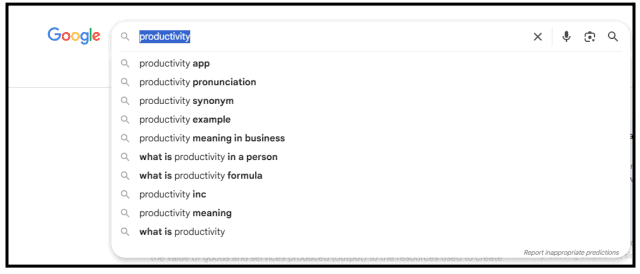
Launch a search query using the keyword “Productivity.”
Before you launch the query, Google will suggest other topics, such as “productivity app,” “productivity pronunciation,” and “productivity synonym.”
If you scroll down, you’ll see a section called “People Also Ask,” which summarizes topics related to productivity that people are searching for.
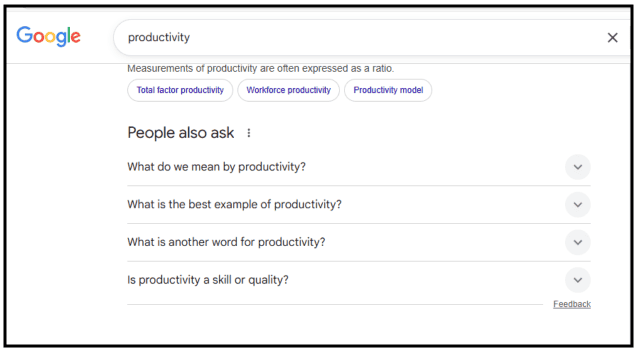
Based on your audience profile, the following topics would meet their interests:
- What is the meaning of productivity in business?
- Is there a formula for productivity?
- What is productivity?
- Why is productivity important?
- What are the productive habits of successful people?
- Is productivity a skill or a quality?
- Are people born productive or can it be learned?
Organize the productivity topics in a spreadsheet file.
3. Create a Blogging Calendar
The logical next question is:
“How do I schedule the writing and publication of the blogs?”
We recommend creating an outline that makes the learning process easier for the reader.
For example, begin the productivity series with “What is Productivity?” Then, publish the rest of the topics in the following order:
- “What Is The Meaning of Productivity in Business?”
- “Is There a Productivity Formula?”
- “How To Have a Productive Workday”
- “Are People Born Productive Or Can It Be Learned?”
- The Productivity Habits Of 10 Successful People”
You can create a content writing calendar where a specific topic is featured on a particular day of the week.
For example: Writing Schedule for January
- Monday: Productivity
- Wednesday: Financial Management
- Friday: How-To articles
In February, the writing schedule could be different:
- Monday: Career Planning
- Wednesday: Wealth Creation
- Friday: Health and Wellness
4. Optimize for Search Engines (SEO)
Google has updated its search ranking algorithm over the years. It’s essential to make sure your blogs are easy to find, read, and understand, not only for users but also for search engines.
Here are six tips on how to optimize your blogs for search engines.
- Structure Your Blog for Readability. Use bullet points and headers to organize your blog and make it readable for mobile users.
Remember our key stat:
People only spend 96 seconds reading a blog.
Structuring your blog for readability makes it easier to skim on mobile phones.
- Prioritize Search Intent. Give users what they want from the start: the answer to their search intent, as we did in this blog. Go back and re-read the opening paragraph.
- Use Keywords Naturally. Keywords are essential to get found by search engines, but they shouldn’t negatively impact readability, context, and overall quality. Incorporate keywords naturally into your blog, as though you’re engaging in a conversation with your readers.
- Implement a Linking Strategy. Links are used to verify information shared in your blog. However, externally link only to reputable and relevant sources. Internal links drive readers to other pages on your website.
- Use Compelling But Relevant Visuals: Images and videos enhance user engagement. Add tags to make your images and videos visible to search engines.
- Follow Google’s E-E-A-T Principle: If you aspire to give the audience more than what they’re looking for, you’ll easily hit 2,500 words. For short-form blogs, if you can fulfill search intent in less than 1,000 words, you’ve done your job.
5. Optimize for AI (GEO)
Generative Engine Optimization (GEO) is optimizing content for Artificial Intelligence.
Google’s AI Overview (AIO) summarizes the answers to search intent into relevant headings and provides links to its references. AIO appears in the top section of the web page and before the SERP.
Links included in the AIO have a conversion rate three times higher than those appearing in the SERP.
Here are six tips on how to do effective GEO.
- Follow Google’s E-E-A-T Principle. AIO indexes high-quality content that offers users useful, valuable, and relevant information from authoritative and trustworthy sources.
- Present Your Headers in a Question Format: AI’s Machine Learning (ML), Natural Language Processing (NLP), and Language Learning Model (LLM) programs favor conversational content.
Phrasing your headers in a question format makes it easier for AI to understand your content.
- Write Using Natural, Flowing Language: Similar to users and search engines, the AI search algorithm prefers content written with natural and flowing language that’s easy to read and understand.
Remember, a blog is a conversation between you and the audience.
- Structure Content: Use bullet points and headers to organize content and to enhance readability.
Use this blog as your reference!
- Incorporate Long-Tail Keywords: Long-tail keywords initiate an AIO summary because they provide more information and are often phrased as a conversation. Long-tail keywords are especially beneficial for local SEO and help local businesses get found by AI search.
- Frequently Update Content: AI will ignore outdated content. If possible, update your blog content monthly.
6. Edit and Proofread Your Blog
Spelling mistakes and grammatical errors will leave a negative impression on your audience.
- Proofread your blog after your break time, before you log out, and first thing the following day when your mind is well-rested.
- Use spelling and grammar checking software, such as Grammarly.
- Ask a friend or a colleague who’s also a writer to check your blog for errors.
These types of errors can be seen as red flags. Readers might perceive your business as irresponsible, unconcerned, and careless.
Lastly, run your blog through a plagiarism checker, such as Copyscape.
Plagiarism can carry a monetary fine, a jail term, or both.
7. Finish Strong
Keep your conclusion short, but finish strong.
- Summarize the key points of your blog in a few sentences.
- Add a powerful, compelling, and decisive CTA that tells the audience the next steps they need to take.
- Don’t add new information that might contradict the blog or confuse the audience.
Conclusion
Long-form blogs that range from 2,500 to 3,000 words rank higher than short-form blogs, but word count must not compromise content quality.
Focus on creating blogs that offer high-value, useful, relevant, and updated information to the audience. The blogs must be well-researched, properly linked, thoroughly edited for mistakes, and optimized for search engines and AI.
Short-form blogs have their place in a content marketing campaign. They’re easier to read and write, less costly to make, mobile-friendly, and adaptable to multiple platforms.
An effective blogging strategy includes producing both long and short-form blogs to achieve various business development goals.
Creating high-quality blogs takes time and effort. This blog took four hours to write.
Dedicate your working hours to your business. Outsource content writing to us, and we’ll write optimized blogs that deliver measurable results.