

Commercial malls. Landline phones. Fax Machines.
What do these things have in common?
They are things that people hardly use today because there are better options: Online shopping, smartphones, and email.
Add traditional search results to the list.
More people are starting to favor AI summaries over traditional search results because of their accessibility, convenience, and assurances of accuracy and quality.
Everything users need as a definitive response to their query: a comprehensive summary, brand mentions, and cited links are included in the AI-generated search result.
As a bonus, the AI summary is near the top of the SERP, before the traditional search rankings.
Why will the user scroll down to view the search rankings when the AI summary has provided the answer to their query… and more?
Not only has AI influenced user behavior, but it has changed the search landscape.
You must realign your SEO strategy and incorporate practices that optimize AI search.
SEO alone won’t produce results.
Why SEO Alone Isn’t Enough: User Dissatisfaction And The Impact Of AI On Google Search Rankings
People still go to malls. Telcos still offer landline subscriptions. 17% of businesses still use fax machines.
They still have value, although it’s safe to say that their heydays are behind them.
SEO remains valuable, but it’s not enough.
Even if your content lands in the first position of the SERP, you’re not assured of website traffic and clickthroughs.
There are two reasons users are ignoring traditional search rankings: user dissatisfaction and AI.
1. User Dissatisfaction
Search Engine Optimization (SEO) helps businesses become visible and indexed by search engines, but consumers often find their experiences clicking on ranked links less than memorable.
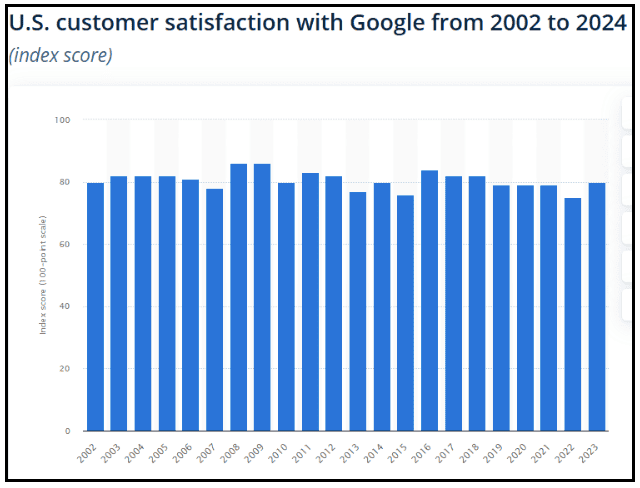
Here’s a 2026 chart from Statista showing the ebbs and flows of American user satisfaction with Google from 2002 to 2023:
(Source: Statista)
Google search’s current score of 80/100 isn’t bad.
It’s higher than Google’s score last year of 75/100, which was a historical low. However, 80 is considerably lower than the high score of 86 in 2009.
17 years ago.
Why are Americans dissatisfied with Google search results?
A 2024 study by researchers from Leipzig University and the Center for Scalable Analytics and Artificial Intelligence identified two factors that negatively affected users’ experience with Google:
- Poor-quality content
- Black Hat marketing practices
Google search results are providing Americans with websites that feature poorly researched content with outdated, irrelevant, and unusable information.
Worse, many web pages have been found to engage in unethical Black Hat marketing practices intended to deceive users and manipulate search rankings.
A study by software developer Soax, revealed that malicious bots accounted for 49.6% of web traffic. These bad bots were designed to carry out criminal activities, including stealing confidential data, DDoS attacks, and credential stuffing.
The prevalence of poor-quality content and deceptive Black Hat practices has kicked the global market search door wide open for a new player to come in.
2. The Rise of AI Search Technology
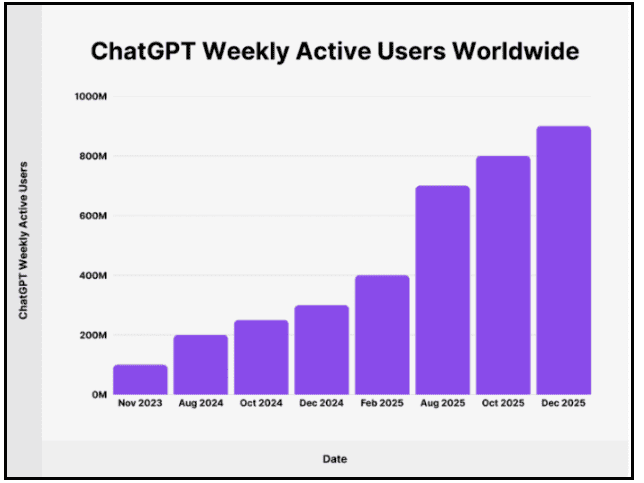
Since ChatGPT’s launch on November 30, 2022, the generative AI chatbot has amassed a total of 900 million weekly active users.
(Source: Backlinko)
ChatGPT controls 80.51% share of the AI chatbot market, far ahead of the competition:
- Perplexity: 7.89%
- Google Gemini: 7.18%
- Microsoft Copilot: 3.5%
- Claude: 0.92%
- Deepseek: 0.01%
Within three months of ChatGPT’s release, Google launched Bard, its initial venture into the world of generative AI LLM chatbots. Bard’s current iteration is Gemini, which was introduced in 2024.
Ironically, it was Google’s venture into AI search, AI Overviews (AIO), that disrupted web traffic.
AIO produces a comprehensive summary that organizes information relevant to a user’s query into readable and accessible information, complete with brand mentions and cited links.
The impact of AIO on Google search rankings was significant.
- 50% of users who encounter AIO don’t scroll to traditional search results.
- 26% of users terminated the search after reading the AIO summary.
- 58.5% of searches in the U.S. produced zero clicks.
- 59.7% of searches in Europe produced zero clicks.
- Less than 1% of users who read AIO will click on the cited links.
- The once-mighty first position in the SERP lost 34% clickthroughs since AIO.
The introduction of AIO reduced website traffic and clickthroughs because it provided users with a convenient and accessible option for finding answers to their queries.
- The AI summary provided a comprehensive response with headers that discussed relevant, useful, and informative topics.
- Brand mentions featured products and services recommended by AI.
- Citations were perceived as links or sources that were analyzed and pre-qualified by AI.
- AIO was located in the top section of the SERP and was immediately visible to the user.
Why click on a traditional search result that potentially contains poor-quality, spammy content, and malware?
You might be thinking:
“If AIO didn’t give users a reason to scroll to the traditional search results, why do I need to optimize for AI and Google search rankings? I could just focus my efforts on enhancing AI search visibility.”

Why You Must Optimize For AI And Google Search Rankings
Because not all queries produce an AI summary.
According to a Semrush 2025 study, only 16% of queries triggered AIO. A 2025 Pew Research Center study showed a slightly higher number: 18%.
AI isn’t a new technology. You can trace its roots back to the 1930’s with Alan Turing’s “Turing Machine,” which sought to provide answers to queries from stored memories.
However, generative AI technology with an LLM system built with Machine Learning (ML) and Natural Language Processing (NLP) programs only came into prominence with ChatGPT’s launch in 2022.
The learning technologies are still a work in progress when it comes to analyzing context and processing accurate responses.
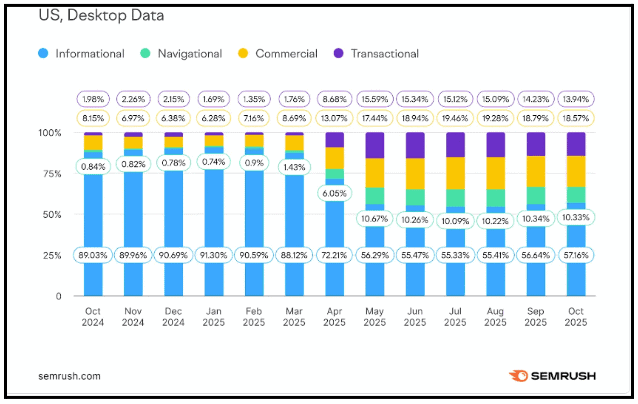
Presently, informational queries trigger 97.7% of AIO. Commercial, transactional, and navigational queries only generate 12.83%, 2.85%, and 1.23% AIO, respectively.
Recently, Semrush notes that the occurrence of AIO among these types of queries has been increasing:
(Source: Semrush)
AI’s advancement in understanding human context is inevitable. In a few years, AI technology will have the capability of processing more complex queries, analyzing larger datasets, and producing accurate responses.
McKinsey projects that in 2028, AI search will further erode web traffic by 20% to 50%. More significantly, decision-making on purchases will shift to clicks on links or brand mentions included in the AI summary.
“Okay, so AI will continue to grow. What then is the purpose of SEO if AI continues to claim Google’s share of the global search market?”
Brand visibility.
AI’s LLM programs analyze different types of data:
- Text
- Images and Videos
- Audio
- Numerical
- Structured
- Unstructured
- Time-series (stock market prices, weather patterns)
- Graphs
AI pulls the information from multiple sources:
- Community forums
- Social media
- Review sites
- E-commerce
- Online search directories
- Search engines
- Online publications
- Online medical and scientific journals
Below is a table summarizing AI’s top 10 sources of information:
| Source of Information: | Percentage: |
| 40.1% | |
| Wikipedia | 26.3% |
| YouTube | 23.5% |
| 23.3% | |
| Yelp | 21% |
| 20% | |
| Amazon | 18.7% |
| TripAdvisor | 12.5% |
| MapBox | 11.3% |
| OpenStreetMap | 11.3% |
SEO’s standard practices, such as using high-ranking keywords, creating high-quality content, regularly posting and distributing blogs and other forms of content on multiple platforms, incorporating backlinks, and ensuring excellent user experience, help enhance online brand visibility.
Building an audience, earning positive reviews and five-star ratings, securing favorable testimonials and mentions from influencers, and gaining backlinks will create enough online buzz for AI to notice your content.
In the next section, we’ll explain Generative Engine Optimization (GEO), the process that focuses on having your content found, analyzed, mentioned, or cited by AI.
As you’ll learn, integrating GEO practices into your SEO strategy only requires slight modifications.
💡Pro Tip: Optimize for both AI and Google search NOW, while AI still accounts for a small share of the global search market. It will be difficult to catch up with your competitors once AI blows up.
How To Optimize For AI And Google Search Together
Optimizing for AI and Google search requires some work, but it isn’t complicated.
The challenge is changing your mindset.
You’re no longer just targeting search engines. You’re readjusting your focus to improve visibility to AI.
1. Adopt GEO Practices
GEO is to AI as SEO is to search engines.
What does it take to make your content visible to AI?
You’ll be pleasantly surprised to find out that it’s really not much at all.
- Incorporate keywords, but don’t force them into the content. Utilize them without disrupting the context or conversational flow of natural human language.
- Use only authoritative and trustworthy sites as sources to validate shared information.
In addition to the sites we identified as AI’s primary sources, credible references include government pages and reputable agencies, such as Reuters, CNN, Bloomberg, Forbes, and BBC. - Establish authority on a topic by creating multiple pieces of related content and outlining their connections to one another. Think of it as using AI to connect the dots in your content strategy.
- Highlight your wins. Did your product get a five-star rating from Amazon? Have customers messaged you to express their happiness about your service?
Let AI know by sharing your wins on social media, community forums, and your website. - Stay active online. Engage with your followers on social media. Respond to comments. Share your expertise on LinkedIn, Quora, and Reddit.
- Start a Wikipedia page, if you qualify, and manage it properly. Wikipedia is a valuable resource for AI, builds your brand identity, and assures that information about your business is accurate.
- Ensure that your website provides an excellent user experience. Users who click a link from the AI summary are highly engaged and motivated to transact.
Don’t disappoint them with a poorly-designed website.
Always entrust your website to a professional web design agency.
💡Key Takeaway: Incorporating GEO practices won’t significantly alter your current SEO strategy.
2. Satisfy the AI Overview Algorithm
An effective SEO strategy aligns with Google’s ranking factors, but you can enhance your content’s visibility to AI with adjustments that comply with its algorithm.
- Incorporate Schema Markup: Schema markup is a code attached to a website’s HTML to help search engines understand its content. However, schema markup or structured data also organizes information, improves content clarity, and page visibility for AI.
- Frequently update or refresh content. If some new developments and trends have changed outcomes, explain them and update relevant statistics.
- Target the Number One Position in the SERP: Despite declining web traffic and clickthroughs, landing in the top position of the SERP can still help your content get found by AI because its algorithm favors high-ranking sources.
- Compete for Relevant, High-Ranking Keywords: LLMs have a propensity for co-ocurrence bias, which favors words or terms that frequently appear together.
Frequent mentions of your brand using top-ranking keywords can help AI recognize it as a leading response to domain-relevant queries.
💡Key Highlight: Optimize for both AI and Google search because landing in the first position of the SERP doesn’t assure an automatic mention or citation in the AI summary.
3. Utilize Question-based Keywords
As we mentioned, informational queries trigger the highest occurrence of AI summaries.
The reason for this is that AI’s LLMs were developed to understand and learn human behavior by analyzing natural conversational language.
A typical search engine query is composed only of keywords:
“Remedy earache”
An AI search query includes more details and is phrased as a conversation:
“How do I remedy an earache at home?”
Incorporate question-based keywords in your content as headers, FAQs, or topics to match conversational-type queries. In combination with schema markup, they help AI understand your content.
4. Optimize Content for Featured Snippets
A featured snippet is a highlighted section of a web page that Google has qualified as a quick response to a user’s query.
Like AIO, featured snippets are activated by informational queries. Optimizing content for featured snippets can help create AIO summaries.
Here are three tips on how to optimize your content for featured snippets:
- Use bullet lists or a numbered format to summarize data, instructions, or rankings.
- Keep the answers short or no more than 60 words.
- Place statistics, key figures, definitions, and process summaries in your introductory paragraph or near the top of the page.
And as we explained in the previous section, use question-based keywords in your headers.
5. Create AI-Friendly Content
Do you remember the guiding principle of writing content?
“Make sure a six-year-old can understand it.”
The same rule applies to AI.
Here are four tips on how to create AI-friendly content:
- Avoid technical jargon. Always think in conversational language. How would you pose the question or statement during a conversation?
- Be concise; use short and simple sentences that articulate your main points. Two to three sentences per paragraph is fine. Keeping paragraphs short helps content become more scrollable.
- Answer user intent in the opening paragraph or introductory section. Don’t use tactics to manipulate the search rankings.
An example of a manipulative tactic is providing the answer to the query in the middle section or after 800 words to improve the time on page and bounce rate metrics. - Organize your content into sections: Headers, key highlights, and FAQs.
💡Pro Tip: When you’re writing content, think about educating AI, not just the human audience.
Remember, Machine Learning technology studies human behavior. If your content is readable and creates a convenient learning environment for humans, it’s good enough for AI.
6. Utilize a Combination of Media
As you saw from its top 10 sources of information, AI processes a variety of media to understand data, including text, video, graphics, and diagrams.
If you’re writing an article, integrate relevant visuals that support the topic every 500 to 700 words.
A good example is this article.
We added visuals to augment the learning process. Images, graphics, tables, and charts help the audience understand text content, highlight key points, and gives their minds a much-needed break from reading hundreds of words.
If you’re having an easy time understanding why SEO alone isn’t enough, so will AI.
7. Stand Out From the Competition
Research plays a significant role in content creation. Before we input ideas into the word processor, we consult multiple sources to enhance our understanding of the topic.
We want to take the content creation process a step further.
It’s not enough to be competent about the subject matter.
Be the expert.
Become the leading topic authority.
Stand out from the competition by providing AI information that it can’t find anywhere else.
- Share proprietary information through actual experiences presented as case studies.
Begin by providing the audience with background information on the situation, the parties involved, the problem that needed to be solved, the challenges faced, and the actions taken to resolve the issue. - Support the case studies with actual data that’s presented as tables or graphs. Add proprietary images, diagrams, flow charts, and screenshots.
- Include testimonials from clients involved in the case studies. Embed a link to your website or a YouTube video where your audience can view and listen to the actual testimonials from your clients.
- In the author byline, share your credentials and relevant experiences about the topic.
- Follow Google’s E-E-A-T guideline. E-E-A-T is the abbreviation for Expertise, Experience, Authoritativeness, and Trustworthiness.
Sharing personal experiences aligns with these four guiding principles for creating high-quality content.
Let’s sum up this section in three words:
Own Your Content.
Referencing valid sources is a responsible approach to content creation.
However, you’ll offer content similar to that of millions of other creators who reference the same sources.
Become a citable source by creating a brand that’s built on expertise, experience, authoritativeness, and trustworthiness. Provide AI with fresh perspectives and unique solutions supported by proprietary data that’s unique to your brand.
Conclusion
Google recognized that user behavior was changing.
AI provided users with an easier, more convenient, and accessible option for answering their queries. Investing in AI allowed Google to strengthen its commitment to provide users with an excellent experience.
AI wasn’t the enemy. It was the lighthouse that guided Google to the new direction in search:
Conversational search.
SEO is great for climbing organic search rankings, but you should realign your focus to target AI brand visibility as well by combining it with GEO.
Incorporating GEO practices will enhance your SEO strategy because it encourages creators to roll up their sleeves, put in the hard work, and assure the audience of high-quality content every time.
It discourages shortcuts to generating web traffic and click-throughs by using deceptive Black Hat tactics.
SEO and GEO are complementary, not contradictory strategies. They are two heads of the same optimization coin.
We hope our guide helped you understand why it’s important to optimize for AI and Google search.
If you need more information, schedule a FREE 30-minute consultation with our team, and we’ll map out an AI + Google optimization game plan for your business.
Frequently Asked Questions (FAQs)
1. Will optimizing for AIO also optimize for ChatGPT?
Yes, because both AIO and ChatGPT utilize LLMs to process, analyze, and learn from multiple data sources.
However, the approach to optimizing content might vary slightly as AIO prefers content that’s frequently referenced while ChatGPT favors conversational responses and topic authority signals.
2. How do I know if my AI + Google optimization strategies are on the right track?
You’ll know if your AI + Google optimization strategies are on the right track by tracking results and measuring performance monthly.
To track results, you can use AI tools such as OmniSEO, Semrush AI Toolkit, and Ahrefs Brand Radar.
To measure performance, include metrics that focus on AI visibility. The key metrics are citation frequency, brand mention visibility, search impressions in AIO, engagement beyond clicks, brand share of voice, sentiment analysis, and brand analysis.
For more information, click this link to read an article we wrote about tracking and measuring AI visibility.