

SEO specialists spend time and energy researching keywords, building backlinks, and crafting high-quality optimized content to win a piece of the most valuable piece of real estate in the global search market: Page one of the SERP.
With millions of blogs, videos, images, and other types of content posted online daily, the competition for a page one ranking can be fierce.
However, if your current digital marketing strategy remains focused on climbing up page one rankings, you might fall short of your goals.
The emergence of Artificial Intelligence (AI) has diminished the influence of page one rankings. It’s no longer what it used to be.
Website traffic has declined by almost 50% and zero-click-throughs have become prevalent. The much-sought-after first position, which previously accounted for 39.8% of page one traffic, generates 34% fewer clicks.
It’s no longer enough to be seen by search engines.
Your brand must be mentioned by AI.
In this article, we’ll discuss why AI mentions are becoming more valuable than page one rankings and how to get your brand included in the AI summary.
What Are AI Mentions?
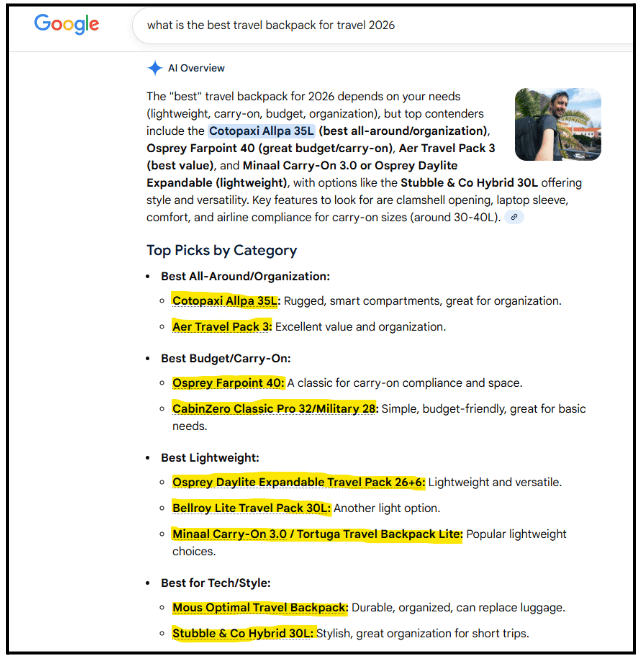
AI mentions are direct references to specific brands in an AI-generated summary.
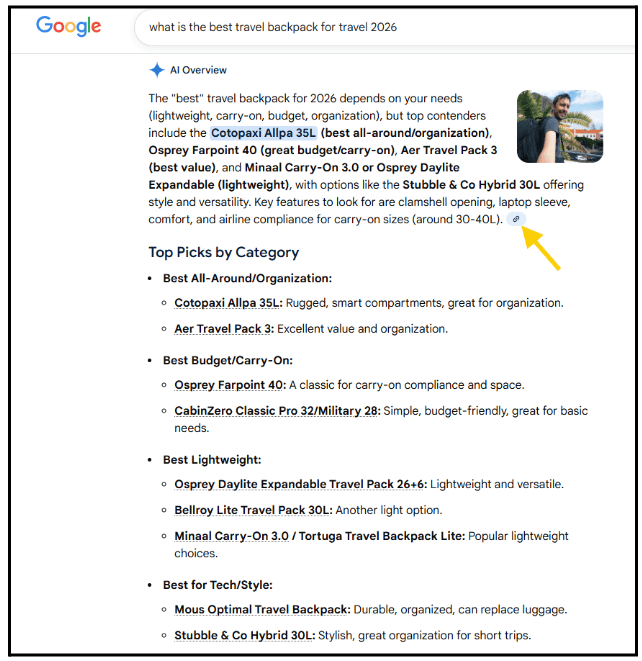
An AI mention isn’t the same as an AI citation, which specifies a link used as a resource to create the summary.
Let’s run a test. Type the following query:
“What is the best travel backpack for travel 2026?”
In the screenshot below, the yellow-highlighted brands are examples of AI mentions:
In contrast, the yellow arrow points to the AI citation:
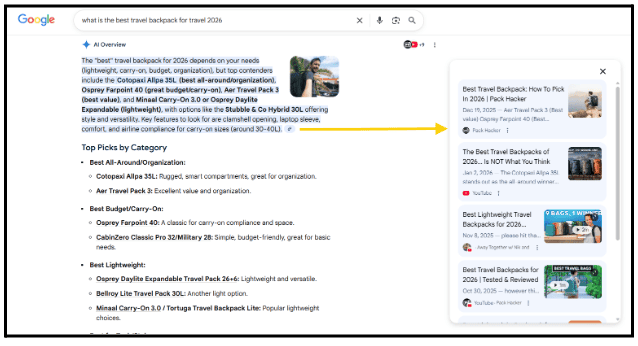
If you click the AI citation, you’ll see a list of sources on the sidebar:
If you were the user, would you still scroll to the search results below?
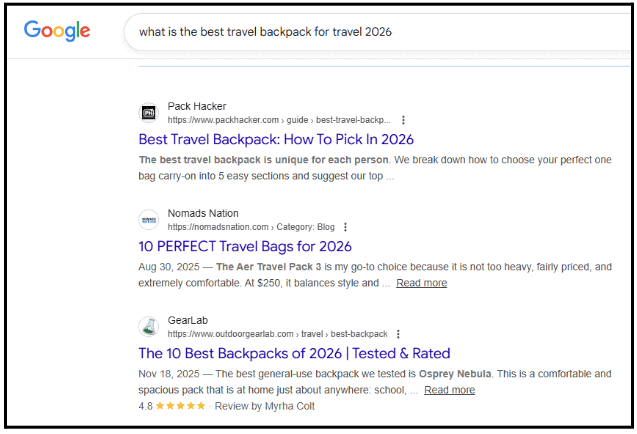
Probably not because AI Overview (AIO) already provided the following:
- Answer: “The best travel backpack for 2026 depends on your needs.”
- Recommended Brands (AI Mentions): Cotopaxi Allpa 35L and Aer Travel Pack 3 (Best Overall Value).
- Recommended Links (AI Citations): PackHacker website and various YouTube channels.
What do the numbers say?
Why AI Mentions Could Be The New Page One Ranking
According to a Pew Research Center study, 15% of users click websites listed on the SERP. However, website clicks drop to 8% when users encounter an AI summary.
An AI summary, which incorporates both AI mentions and AI citations, has led to a nearly 50% decline in website traffic.
If your SEO efforts succeeded in getting your web page to the number one position, pat yourself on the back.
Unfortunately, your joy might be short-lived.
A study by Ahrefs revealed that the first position on page one lost 34% of its clickthroughs due to AI summaries.
In some cases, websites lost 40% clickthroughs.
The study demonstrates that focusing solely on search rankings is no longer sufficient to enhance your online presence.
You must be visible to AI as well.
Thus, SEO isn’t enough.
You must incorporate Generative Engine Optimization (GEO) strategies into your digital marketing campaign to have your content visible to AI. We’ll discuss GEO later.
However, showing up as an AI citation in the summary also isn’t enough.
AI mentions are another story.
How AI Mentions Influence User Behavior
The Pew Research Center study revealed that only 1% of users clicked on AI citations.
The study also disclosed that 26% of users ended their search after reading AIO, while 34% left and browsed other sites.
Thus, while AI summaries have rerouted traffic from traditional search results, having your website cited by AI doesn’t appear to improve clickthroughs.
AI mentions are a different story.
An AI mention means generative AI’s complex Large Language Model (LLM) programs, after processing and analyzing massive amounts of datasets from multiple sources, have acknowledged your ideas and work in the industry.
An AI mention tells users:
“This is the brand you’re looking for.”
As numerous psychology studies have concluded, purchasing is more of an emotional than a rational decision. For users, an AI mention elicits a variety of emotional responses:
- Relief at finding the answer to the query.
- Assurance of having the best answer to the query.
- Confidence in resolving the cause of the query.
- Satisfaction knowing they can go about the rest of their day.
Users also have concerns about the quality of website links in the search results.
Marketers with malicious intent can attempt to manipulate website rankings by employing black hat practices, including keyword stuffing, deceptive redirects, and link buying.
Here’s another cool thing about AI mentions:
The AI mention might not include a link to your webpage, and that’s fine. With an AI mention, users become aware of your brand, understand what it is, how it works, and why it provides a solution to their query.
💡Note: Although Google hasn’t released its data on AI clickthroughs, the search engine giant maintains its position that having your website links included in AI produces higher clickthrough rates than traditional search results.
Why An AI Mention Is The New Success Metric
A 2025 study by the Pew Research Center showed that 53% of Americans trust AI summaries, while 52% found the information useful.
Similarly, the 2025 Consumer Adoption of AI Report, which surveyed consumers based in the U.S., the United Kingdom, Canada, and Australia, disclosed its findings that 43% of respondents trust AI summaries more than paid search results.
Growing consumer confidence in AI search is also evident in the e-commerce sector.
Adobe conducted a survey that showed 39% of consumers used generative AI to shop online and perform related tasks, resulting in a 1,200% increase in traffic for U.S. e-commerce sites.
These shopping-related tasks are focused on finding specific brands:
- Research: 55%
- Receive product recommendations: 47%
- Look for good deals: 43%
- Solicit ideas for gifts: 35%
- Search for unique products: 35%
American businesses have taken notice.
Emarketer projects U.S. businesses will spend $25 billion annually on AI-focused advertisements by 2029 – a giant leap from the one billion spent in 2025, to have their brand mentioned by AI.
Some businesses aren’t waiting for 2029 to capitalize on opportunities created by AI search.
In May 2025, Shopify revealed that AI tools are allowed to access its Catalog API and read prices, titles, and inventory in real-time. Likewise, Amazon, the biggest e-commerce platform in the industry, opened its datasets to AI agents.
Businesses have seen the numbers. They realize that showing up on page one results isn’t enough to entice users to visit their websites.
By nature, people are impatient. They want to get results immediately so they can go about their day.
An AI summary provides just that because it provides all the information they need to make an educated decision:
- Structured answer
- AI mentions
- AI citations
The most visible of these three components, and the one that creates more noise, is AI mentions.
Here’s why.
1. AI Mentions Simplify The Purchasing Process
An AI mention potentially creates a one-step purchasing process. Users have the information they need to finalize their decision:
- Brand name
- Product description
- Pros and cons
- Price
- Awards
- Reviews
- Ratings
Unless a user is further down the sales funnel and views the purchase as urgent, there’s no need to click a website link or an AI citation.
Some users might decide to put off the purchase until payday, wait for better deals, sleep on it for a few more days, or prefer to purchase the item from a brick-and-mortar store that carries the brand.
The bottom line is that AI mentions accommodate different types of user behavior – brand-focused, urgent, impulsive, discerning, patient, loyal, discerning, and promotion-driven, to name a few.
2. AI Mentions Build Brand Trust and Identity
If your brand is mentioned, you don’t have to be concerned that your website link isn’t cited because its identity is in the user’s consciousness. Your brand will be top-of-mind.
With an AI mention, if users are convinced, they will find you.
Rankings are keyword-focused and represent what users click frequently, regardless of purpose or need.
AI mentions don’t care much about keywords. AI looks for brands it can trust.
3. An AI Mention Is An Assurance of Quality Content
A webpage could appear in the first position because of keyword usage and its adherence to other algorithm ranking factors.
It’s also possible that malicious bots contributed to its surge in website traffic.
A 2023 Soax study revealed that malicious bots accounted for 49.6% of online traffic.
An AI mention is a recommendation that’s been studied, analyzed, and processed by powerful LLMs.
It’s not influenced by bad bots.
In the age of search engines, the most powerful metric for success is page one rankings.
In the age of AI, the most powerful metric for success is visibility – AI mentions.
How To Get AI Mentions For Your Brand
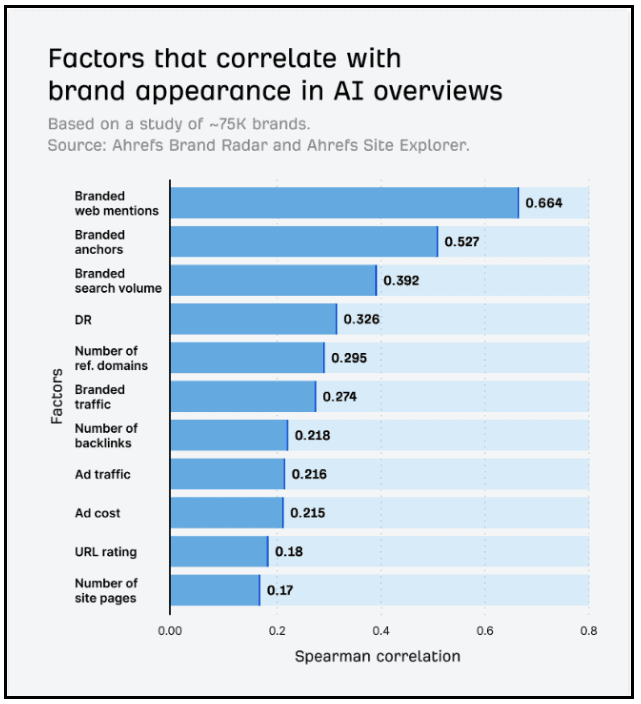
In 2025, Ahrefs conducted a study to determine which search factor generated the highest brand visibility in AI Overviews.
In the study, a larger positive value corresponded to higher brand visibility.
The results are as follows:
(Source: Ahrefs)
Brand web mentions had the highest positive value at 0.664.
In comparison, domain factors or factors associated with the website domain registered unimpressive numbers:
- Domain Rating (DR): 0.326
- Number of Referring Domains: 0.295
- Number of Backlinks: 0.218
- Ad Traffic: 0.216
- Ad Cost: 0.215
- URL Rating: 0.18
- Number of Site Pages: 0.17
According to Ahrefs, the brands with the most brand web mentions generated 10-times more AI mentions.
We’ve listed six ways you can boost your presence across the internet and enhance your brand visibility to AI.
1. Invest in a Business Website
“If click-through rates are down and fewer than 1% click on AI citations, why will I invest in a website?”
Because if your search and generative engine optimization strategies are successful, users would want to learn more about your business, products, and services.
The website is your online business address. Investing in a website sends a powerful trust signal to customers that you’re serious about growing a successful business brand.
Here are three important statistics to keep in mind:
- 33.3% of the global population shops online.
- 84.3% of Americans shop online.
- The conversion rate from AI search is three-times higher than traditional search.
The third statistic is particularly important because those who decide to click on a citation are highly-engaged and highly-motivated to transact with a business.
Users can do everything on your website: Research, browse products, contact customer support, and shop.
Expectations are high. Users anticipate a high-quality experience when interacting with a website.
What qualities define a high-quality experience?
- Mobile responsive – 57% of e-commerce sales are transacted on mobile phones.
- Fast download speed – 53% of users abandon the search if the web page takes longer than three seconds to load.
- Excellent navigation – Poor navigability leads to 55% higher bounce rate and 88% higher cart abandonment rate.
- High-quality content – Optimized for search, unique, useful, informative, and relevant.
Your search and generative engine efforts to enhance brand visibility won’t deliver the desired results if you don’t have a properly designed and optimized website.
If you don’t have a business website or aren’t satisfied with your current one, don’t go the DIY route.
Let a professional and experienced web design agency build one for you.
2. SEO Remains An Integral Component Of Your Brand-Building Strategy
The Ahrefs study showed that search engine visibility remains important despite the growing influence of AI summaries.
To be seen by AI, your brand must be visible online. That’s the job of SEO.
The basic framework of an SEO strategy incorporates practices that align with the AI’s search algorithm:
- Address search intent.
- Utilize high-ranking keywords.
- Ensure excellent user experience.
- Create high-quality content that corresponds with Google’s E-E-A-T guideline.
- Develop a link-building strategy that utilizes only relevant, authoritative, and trustworthy sources.
- Track and measure performance.
As you’ll learn in the next section, you don’t have to modify your SEO strategy much for your content to become visible to AI.
3. Incorporate GEO in Your Digital Marketing Strategy
Generative Engine Optimization (GEO) involves the application of techniques and processes that enhance content visibility to AI.
It’s SEO for AI.
SEO and GEO are opposite heads of the same optimization coin.
Adjusting to GEO only needs more details.
- Address search intent… preferably, immediately, and provide users with headers that cover topics relevant to their search query.
- Utilize high-ranking keywords… but don’t force them into the content and affect the flow of natural human language.
- Ensure excellent user experience… by writing conversationally and structuring content for readability.
- Create high-quality content that corresponds with Google’s E-E-A-T guideline… include personal experiences that are relevant, useful, and informative.
Highlight social proof, such as customer testimonials, positive mentions, favorable comments, emphatic recommendations, and five-star ratings from trusted consumer review sites.
- Develop a link-building strategy that utilizes only relevant, authoritative, and trustworthy sources… AI trusted sources include government websites, reputable media platforms, openly accessible community forums, and respected research publications.
Examples are the Bureau of Labor Statistics, USA.gov, Forbes, Reuters, Reddit, Wikipedia, Pubmed, The Economist, and The Washington Post.
- Track and measure performance… by focusing on a set of KPIs that are different from SEO.
Instead of CTRs, bounce time, and organic sessions, focus on relevance, frequency of retrievals and citations, and semantic density.
💡Pro Tip: Incorporating both optimization strategies into your digital marketing plan will create a comprehensive approach that meets the needs of AI and search engines.
4. Apply Socratic Questioning
Socrates was an ancient Greek philosopher who advocated thoughtful questioning as an effective method for validating ideas.
Socratic Questioning encourages practitioners to ask open-ended questions until they arrive at a comprehensive and satisfactory answer. It’s a novel approach to finding topics that are relevant and useful to the original query.
Applying Socratic Questioning to our sample conversational query, “What is the best travel backpack for travel 2026,” we can come up with the following topics:
- How to Select the Best Travel Backpack
- What Are the Key Features of a Durable Travel Backpack?
- How to Clean and Maintain Your Travel Backpack
- 5 Best Tips to Pack Your Things Inside the Backpack
The Socratic Questioning method challenges you to push the boundaries of creative thinking.
As the content creator, you put yourself in the position of the user and ask:
“What more do I need to know?”
💡Pro Tip: Expand the coverage of your content and include relevant topics that competitors may have overlooked.
5. Teach Your Audience… and AI
Users prefer content that makes learning easy… and so does AI. The more the content is accessible, readable, understandable, and “answer-ready,” the more likely AI will reference it.
Here are seven tips for creating an effective lesson plan for teaching AI:
- Provide clear definitions.
- Break down complex terms into simpler language.
- Include step-by-step explanations, with images, if necessary.
- Highlight key points with takeaways, pro tips, notations, and emojis.
- Utilize tables, charts, and infographics as visual aids.
- Write from a question-first perspective: “What is it?” “How does it work?” “What are its benefits?”
- Reference up-to-date statistics and figures to substantiate shared information.
- Include an FAQs section.
💡Pro Tip: When creating content for AI, greater clarity improves the probability of mentions.
6. Ensure A Strong and Consistent Brand Identity Online
Part of the AI’s learning process is understanding who you are, what your business is about, what your products and services are, where you can be found, and other information that contributes to your brand identity.
Here are three tips on ensuring a strong and consistent brand identity online:
- Keep your online information updated across all platforms: Website, social media, and community forums.
- Manage your local SEO presence. Open a Google My Business (GMB) account and update its information. AIO references GMB for local searches.
- Maintain topic consistency when creating content.
💡Pro Tip: Consistency helps AI understand who your brand is and what it is about.
Conclusion
With AI, your business isn’t ranked.
It’s recognized.
Your business brand is pulled out, separated, and distinguished from the competition.
If AIO, ChatGPT, Copilot, Perplexity, and other AI tools mention your brand in their summaries, users will perceive your business as a credible, authoritative, and trustworthy entity.
AI mentions are the new page one ranking. It’s the new backlink, and doesn’t require a citation because it’s a modern authority signal; a badge of recognition, or a stamp of approval.
However, don’t set aside your SEO strategy because search results still matter.
Google still controls 90% of the global search market, and not all queries produce an AI search.
Instead, fortify your SEO strategy by incorporating GEO practices and cover both algorithmic bases: Search engine and AI.
Both disciplines incorporate similar practices that will help you acquire AI mentions and rank high in the search results.
These shared practices include creating high-quality content that meets Google’s E-E-A-T guideline, incorporating high-ranking keywords, and linking to reputable sources.
The difference is in mindset.
When writing for AI, adopt a people-first mindset, not a search engine-first mindset.
Unsure how to go about it? Contact us NOW. Let’s gameplan and get your brand mentioned by AI.
Frequently Asked Questions (FAQs):
1. What is a Page One Ranking?
Page one ranking refers to the list of 10 website links that appear on the first page of Google’s SERP. It’s estimated that more than 90% of users only view the first page of the SERP, with almost 40% of traffic going to the top position.
2. How has AI search affected search engine rankings?
AI search has resulted in a 50% decline in website traffic because users increasingly prefer to read the AI-generated summary. As a consequence, AI search traffic led to zero-click searches, a situation where users don’t click website links.
3. Is AI Search 100% accurate?
No. AI search is powered by learning technologies that pull, analyze, and process responses based on datasets from multiple sources. The sources might provide inaccurate or outdated information. Likewise, AI remains inconsistent when analyzing context.