

An airport is one of the busiest places. Every day, people are flying in and flying out.
If you are flying out, you must:
- Check in your luggage
- Clear immigration
- Have your carry-on checked
- Have your boarding pass inspected
If you have just arrived, you must:
- Clear immigration
- Pick up your luggage
- Go through Customs if you have items to declare
These are the process flows travelers go through in an airport.
The people handling the luggage check-in counter, immigration, carry-on inspection, passenger boarding, and Customs have process flows to follow.
If an airport didn’t have process flows, it would be a maze instead of a travel hub. There would be irate, confused, and stressed-out travelers, and airport and airline employees wouldn’t know what to do.
If your business didn’t have process flows, it would be disorganized and unproductive. You would be irate, confused, and stressed out. Your employees or team wouldn’t know what to do.
You can’t hope to succeed in business just by “winging it.” You need to design, implement, and track process flows.
In this article, we’ll tell you everything you need to know about process flows. At the end of the article, we’ll create a process flow on one of the most important areas of business development.
Key Takeaways:
- A process flow organizes the procedures of a business, increases productivity, introduces efficiency, improves the quality of work, and reduces risk.
- All businesses, regardless of size, type, and industry, need a process flow.
- A process flow functions as a guide for a key area of responsibility. Because each area of responsibility has a different function, it’s important to determine the goals and KPIs of the process flow.
- Begin by putting ideas about the process flow on paper or a whiteboard. Once the process flow has been finalized, transfer it to a digital format.
- Get your team involved in process flow design. Their inputs are valuable in maximizing the strengths and limiting the flaws of your process flow.
What Is A Process Flow?
A process flow explains to users the steps needed to complete a process. The steps are presented in chronological order, are detailed, articulated for clarity, and include all components essential to ensure the smooth flow of the process.
Why Does Your Business Need A Process Flow?
Like an airport, a business has different areas of responsibility:
- Operations
- Human Resources
- Marketing
- Sales
- Information Technology
- Customer Support
- Accounting
Each area of responsibility is guided by a process flow.
A process flow offers several benefits for your business.
- Organize Your Business: Process flows add structure to your business. It removes guesswork. Everyone knows what their responsibilities are and the tasks they need to accomplish daily.
- Improve Communication: In a process flow, positions and their respective roles and responsibilities are clearly defined. Anyone with a question or needing clarification knows whom to ask and how to communicate their inquiry.
- Standardize Procedures: A process flow includes specific instructions on producing goods or carrying out services. Standardizing procedures assures customers of work quality.
- Improve Efficiency: Initially, a process flow can have double-digit steps. As the business grows and gains experience, it can reduce the number of steps to half.
- Increase Productivity: When people know what to do, they maximize their work time and productivity.
- Reduce Mistakes: A process flow is comprehensively designed with a high attention to detail. It identifies potential problems and unfavorable outcomes.
To counter the negative impact of these scenarios, a process flow outlines alternative courses of action and their implementation guidelines. - Lower Cost: Improved efficiency and reduced mistakes lower your cost of business.
- Track Progress: A process flow collects data about the performance of each area of responsibility so you can track their progress. Evaluating performance enables businesses to become agile and adjust process flows as needed.
💡Pro Tip: All businesses, regardless of size, should have process flows. Even freelancers follow process flows created by their clients.

How To Create A Process Flow For Your Business
If you’ve made it this far, it means we’ve convinced you that a process flow is important for your business.
Now, we’ll teach you how to make one.
1. Take It One Area of Responsibility At a Time
Create a process flow that supports the functions and goals of each area of responsibility.
Take it one area at a time.
For example, begin with Operations. After you’ve completed the process flow for operations, design one for Human Resources.
As you’ll find out later, once the process flows have been completed, incorporate them into a general flowchart to assess whether there is synergy among the processes.
2. Establish the Goal of the Process Flow
What does the process flow hope to achieve?
Establishing its goal gives the process flow direction.
Here are examples of process flow purposes for a specific area of responsibility:
- Operations: To increase productivity.
- Human Resources: To hire right-fit employees.
- Marketing: To generate more leads.
- Sales: To convert more leads into sales.
- Information Technology: To enhance network security.
- Customer Support: To improve customer experience.
- Accounting: To keep records consistently updated.
You can have multiple goals, but identify your priority. The goals should be complementary and not disrupt the process flow.
For example, Operations can aspire to increase productivity and improve efficiency. Information Technology can aim to enhance network security while ensuring uninterrupted service.
3. Create A Rough Outline of the Process
Eventually, you’ll transpose your system using business process flow or a basic spreadsheet software.
For now, use a pen to sketch the process flow on paper. This will serve as a rough outline, and writing by hand will help you feel more connected to the process.
You’ll be able to see and sense any changes needed to ensure that the process flow progresses smoothly. If you’re working with a team, get them involved in the process design.
They possess the necessary skills that qualify them for the position. No one understands their roles and responsibilities better than they do. Seek their input and encourage proactive discussions.
4. Test the Process
Your process flow is only theoretical. Time to test your theories!
Testing helps you see the potential issues and flaws in the process flow.
- Does the process flow have redundancies?
- Are you using the correct software?
- Are there aspects of the process flow that can be misunderstood or cause confusion?
- Does the process flow accomplish its goal?
Document and analyze the test results. Apply the necessary improvements and repeat the test. Consider running various scenarios based on potential issues the process flow may face in the future.
If you’re confident with the test results, you’re ready for the next step.
5. Identify the KPIs of the Process
Key Performance Indicators (KPIs) are benchmarks used to measure the performance of the process flow. Each process flow is tailored to support the goals of its specific area of responsibility, resulting in different KPIs.
For example, if the goal of Operations is to increase productivity, its KPIs would be different from Customer Support, which wants to improve customer experience.
Similarly, KPIs will vary from industry to industry.
The KPIs of Operations in Manufacturing will vary from the KPIs of Operations in Healthcare.
Manufacturing operations would most likely focus on productivity. Its KPIs include Overall Equipment Effectiveness, Rolled Throughput Yield, and Gross Margin.
In comparison, Healthcare would prioritize efficiency. Its KPIs include Patient Wait Time for OR, Average Hospital Stay, and ER Wait Time.
Monitoring the KPIs of your process flow will help you evaluate its progress. If it’s lagging, you’ll know where the problems lie and develop solutions that will put it back on track.
6. Create the Process Flow in Digital Format
Are you confident in the final iteration of your process flow?
If so, time to transfer the process flow from paper to digital format.
Canva, Creately, and SmartDraw offer free business process flow templates. You can use them to create a digitized version of your process flow.
Also, you can customize your process flow using Excel, Google Sheets, Google Docs, PowerPoint, or Google Slides.
Digitizing professionalizes your workflow. It’s a clear-cut, visual, and virtual representation that’s accurate and makes the process flow easier for everyone to understand.
💡Pro Tip: Once you have completed all the process flows, combine them into a single workflow. By merging the process flows, you can identify synergies and potential disruptors.
7. Discuss and Distribute the Process Flow
The final step is to distribute the process flow.
Discuss the process flow to make sure everyone understands how it works and to answer nagging questions. Encourage your people to provide feedback.
During the discussion, you might uncover flaws in the process flow. That’s okay. You have the process flow in digital format. Introducing changes will be quick and easy.
A process flow needs to be dynamic and flexible. There is no final iteration since it must evolve as business conditions change.
Sample Process Flow For Content Writing
Let’s put theory into practice!
Here’s a sample process flow for a content writing team.
Content writing is a key component of a digital marketing strategy. High-quality content that’s properly optimized for search engines and created with users in mind will drive traffic to your website.
The keyword is “high-quality.”
You can’t produce content without purpose and strategy and expect it to generate the desired results.
A content writer must have the following skills:
- Creative writing
- Search Engine Optimization (SEO)
- Keyword research
- Topic research
- Knowledge of writing and Quality Assurance (QA) software
If a writer doesn’t have these skills, or if you plan to produce a large volume of articles, you can create a team composed of the following:
- Content writer
- Editor
- Image/Graphic Design
- QA officer
- SEO Expert
Whether you have one-person or a team handling content writing, you’ll need a process flow to increase productivity, reduce mistakes, and ensure quality of work.
The goal of the content writing process is:
To consistently produce high-quality content that drives traffic to the website.
Here are the KPIs:
- Page views
- Bounce rate
- Average time on page
- Average session duration
- Total traffic
- Sources of traffic
- Pages per session
- Organic search rankings
- Keyword performance
- Returning vs new visitors
- Frequency of visits
- Recency of visits
Put your pen to paper or marker to whiteboard.
“How will the content writing process flow work?”
- The writer gets his topic from a Google Sheet file marked “Content Brief.” The content brief summarizes everything the writer needs to create the article, including keywords, SEO description, and headers.
- The writer creates a copy of the Content Brief, which will be the document he will write on. Writers must perform preliminary QA on articles by reviewing them manually and using tools such as Copyscape and Grammarly.
- The writer will share the completed article with the Editing team and attach its Google Docs link to the Google Sheets file, then inform everyone on Slack that the article is ready for review.
- If the Editing team approves the article, it will be sent to the Image team for graphics. If further edits are needed, the article will be returned to the writer for revisions.
- From the Image team, the article will be sent to the SEO officer for proper optimization and a final review.
- Once the SEO officer clears the article, it will be uploaded to the website and shared on the various social pages.
The Content Writing process flow uses three applications: Google Sheets (file sharing), Google Docs (writing), and Slack (communication).
How will the process look in digital format?
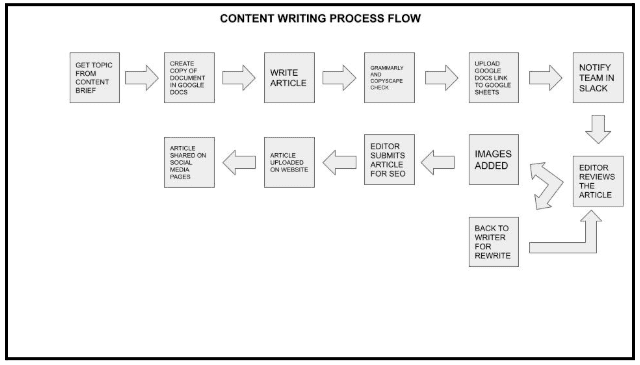
We used Google Slides to create the digitized version of the process flow with a combination of shapes, directional arrows, and text. It’s simple, but easy to understand.
You can incorporate color, images, and other visual elements to enhance the aesthetic appeal of your process flow, but these components must be relevant and should not distract users.
Conclusion
Whether you’re running a one-man enterprise or managing a staff of 100 people, your business needs a process flow.
Process flows organize and standardize procedures, improve communication, introduce efficiency, increase productivity, and lower the risk of making costly mistakes.
These are variables that contribute to business profitability. If you can increase production while expertly managing resources and lowering costs, you’ll be profitable.
Creating a process flow will not take much time. However, the few hours you invest in designing a process flow will yield significant benefits for your business in the years to come.
If you’re creating a process flow for an online business, you need a website.
The website will function as the central hub of online operations. The content you create will be uploaded to the website and shared across your various online channels.
The traffic generated by your content will lead to the website, where the CTAs and copy aim to convert interest into sales.
If you don’t have a website or need a redesign because your current one isn’t delivering results, contact us now.