

Artificial Intelligence (AI) is constantly evolving and introducing innovations that transform how we manage both our professional and personal lives.
We have integrated AI technology into our daily routines to enhance decision-making, improve time management, and streamline planning. This integration ultimately boosts efficiency at work and simplifies everyday tasks.
In the past three years, AI has had its greatest impact on a task that constitutes 40% of our daily activities: Online search.
On average, we spend six hours and 38 minutes online searching for information, communicating with family and friends, or watching videos for entertainment.
AI tools like ChatGPT, Gemini, Perplexity, and Copilot have made online search easier by enabling users to perform conversational search queries.
The shift in user behavior has been slow but steady and has had significant repercussions on Search Engine Optimization (SEO) practices, content creation, and audience interaction.
For e-commerce and other online businesses that have invested in SEO, now’s the time to reassess, realign, and recalibrate your digital marketing strategies because the future of search is here.
And the future of search is conversational.
What Is Conversational Search?
AI tools utilize Natural Language Processing (NLP) and Machine Learning (ML) programs that allow them to analyze the intent and context of user queries.
In just a few seconds, the AI analyzes a user query and provides a conversational, human-like response that matches the context of the search. The response is summarized with relevant headers and reliable sources, written in a clear and easy-to-understand manner.
All the information users need to address a query is conveniently located in one place – the top of the SERP, and before traditional search results.
Let’s say you want to learn how to make Dutch coffee.
When you search for “how to make Dutch coffee,” you’ll see the following SERP:
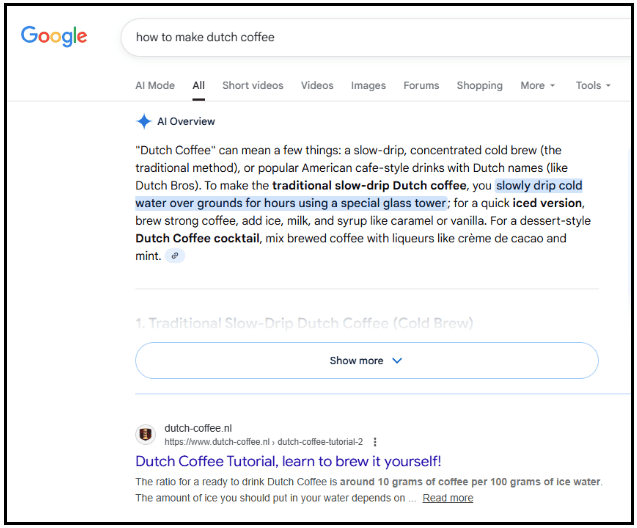
Google’s AI, AI Overview (AIO), appears in the top right corner of the SERP, and before the traditional search results that list websites relevant to the query.
You’ll notice the summary is written in a conversational, easy-to-read, and understandable manner – the same way you’d tell a friend who asked you about making Dutch coffee.
The summary includes links to third-party sources.
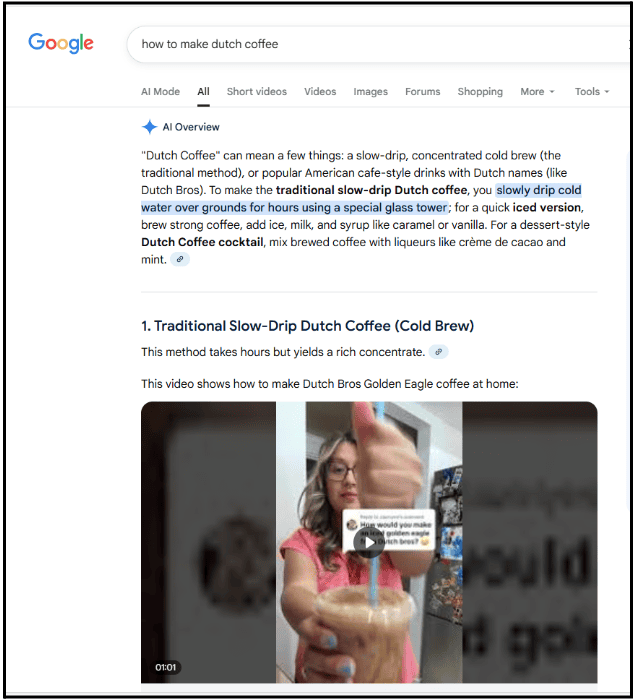
If you click “Show More,” you get more detailed information…
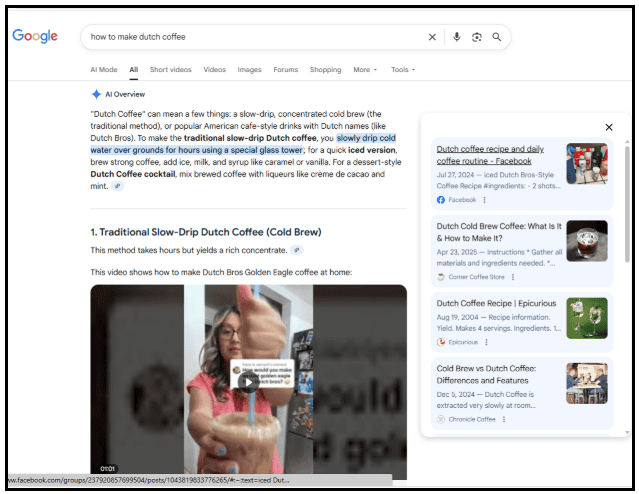
If you click the sidebar, you’ll see web pages recommended by AIO as credible references…
When you already have the answer to your query and references to vetted sources, would you still scroll and view traditional search results?
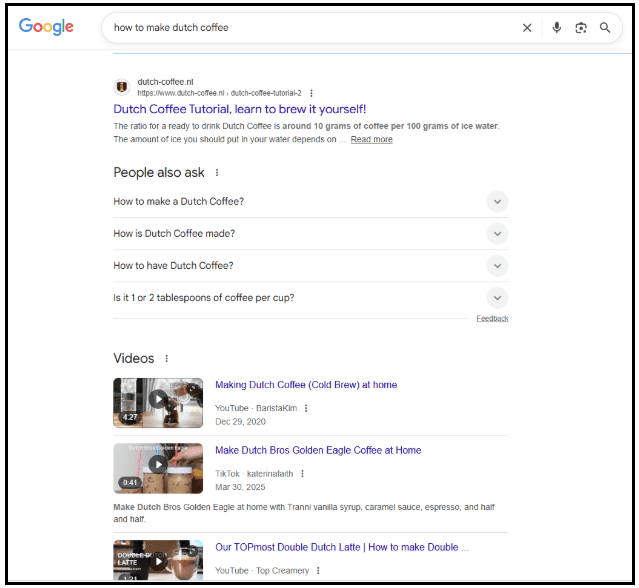
Many of you will probably say:
“No. I have all the answers I need in AIO.”
What do the numbers say?
How Has Conversational Search Affected Traditional Search?
Google remains the King of Search.
As of November 2025, Google controls 89.99% of the global search market. However, in March 2024, Google’s market share was at 91.38%. Google’s declining market share is more evident in the United States market.
In November 2024, Google owned 90.37% of the U.S. search market. It has been on a steady decline since December 2024 and currently stands at 85.07%.
What about AI search?
ChatGPT is the King of the AI chatbots with 81.84% market share. Perplexity is far behind at 11.06%.
In terms of the global search market, ChatGPT versus Google is a classic David versus Goliath scenario.
ChatGPT accounts for only 0.41% of the global search market pie, but its impact, or the stone that staggered the Google Goliath, is on user behavior.
- 15% of users would click a link included in traditional search results. However, the number of clickthroughs would drop to 8% or almost 50% if users encounter an AI summary.
- According to a 2024 report, 15 million Americans reported preferring AI search over traditional search. Statista expects this number to hit $36 million in 2028.
- An Evercore survey of 1,300 Americans revealed that 8% of respondents use ChatGPT over traditional search.
- Gartner believes the shift in user preference toward AI search will reduce search engine volume by 25% in 2026.
- A Bain & Company study showed that 80% of users prefer to reference AI summaries 40% of the time.
- A Forrester study revealed that 89% of customers have incorporated AI tools into the purchasing process.
The change in user search behavior has led to a phenomenon known as zero-click search, where websites do not receive clickthroughs because users end their searches after reading the AI-generated summary.
Software developer SparkToro launched a study in 2024 to measure the impact of AI tools on traditional search results.
According to the SparkToro study, 59.7% of Google searches in Europe ended in zero clickthroughs. In comparison, the zero click-through rate in the U.S. is 58.5%.
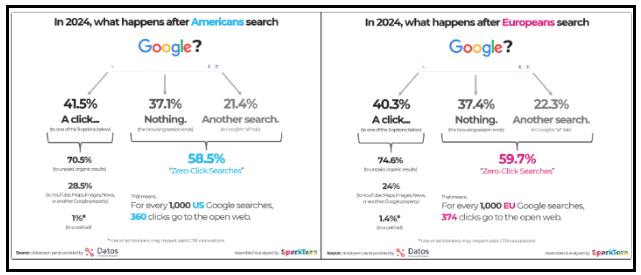
(Source: SparkToro)
That’s almost an almost 60% decline in Google website traffic at a time when AI search accounts for less than 1% of the global search market.
AllAboutAI, a community dedicated to studying the growth of AI, estimates that in 2030, AI search will account for 62.2% of global search volume.
If correct, what would be its impact on Google’s website traffic by then?
The signs are already here:
- ChatGPT has 800 million weekly active users.
- ChatGPT processes two billion queries daily.
- Users send 2.5 billion queries to ChatGPT daily.
- Perplexity grew by 524% in 2024.
- Perplexity processes 780 million queries monthly.
AI search isn’t a revolution. It’s an evolution of search technology. It will continue to grow, evolve, and influence user behavior over the next decade.
Is Your Business Ready For Conversational Search?
If your digital marketing strategy remains solely focused on search rankings, your SEO investment may not yield positive returns.
Search engines rank web pages based on their adherence to specific ranking factors and signals, which include the following:
- Keyword usage
- Quality internal and external links
- User experience: Page responsiveness, download speed, and navigability
- Content quality: E-E-A-T (Experience, Expertise, Authoritativeness, and Trustworthiness)
The drawback with ranking web pages using keyword-focused algorithms is that it doesn’t guarantee users the best results.
Many of you have likely clicked the first link on the SERP, believing it was the best choice, only to be disappointed by the information on the web page.
Conversational search assures users of more accurate results because the query features more details, typically structured as a question, and phrased using natural language.
“What are the best walking shoes for people with flat feet when traveling to Japan in 2026?” is easier for AI to understand than “best walking shoes flat feet Japan 2026.”
Large Language Models (LLMs) run the AI engine, enabling the technology to analyze and understand the semantic context of the query and provide users with results that are perceived as accurate and personalized.
As the numbers have shown, users love the convenience of reading comprehensive AI summaries and appreciate the availability of vetted online links.
Users feel more assured that the links provided in the summary offer relevant, high-value, and up-to-date information.
Another statistic to keep in mind is that voice search usage is growing.
Globally, 20.5% use voice search. In the United States, an estimated 153 million Americans rely on voice search to find information. AI tools such as ChatGPT, Gemini, and Perplexity have voice search capabilities.
If you haven’t modified your digital marketing strategies to accommodate conversational search, you’ll suffer the consequences of zero-click search.
Without clicks, you have no website visitors.
No website visitors means less visibility, fewer brand engagements, and lower sales conversions.
The good news is that it’s not too late to rewrite the strategy playbook and incorporate conversational search in the digital marketing game plan.

6 Tips To Prepare Your Business For Conversational Search
SEO remains relevant, but the decline in website traffic proves it’s no longer enough to be visible to search engines. You must be visible to AI search because conversational search will dictate the flow of traffic.
Here are our six tips on how to prepare your business for conversational search:
1. Incorporate GEO Principles
Generative Engine Optimization (GEO) and SEO are two sides of the same coin. Both processes work to enhance content visibility, but instead of search engines, GEO focuses on targeting the AI search algorithm.
What are examples of GEO principles?
- Create detailed content that offers users accurate, up-to-date information from reputable and credible sources.
- Incorporate high-ranking keywords naturally. Don’t force-fit keywords to comply with the search engine algorithm.
- Write for the audience, not the search engines. You’re the expert. They want to learn from you.
Avoid using technical jargon and long, complex sentences. Break down definitions and terms using easy-to-understand language. - Increase your multi-platform presence by collaborating with non-competing brands and influencers.
- Solicit reviews and ratings from customers. Highlight positive feedback on your website and social media pages.
- Present headers in question format. Review this article. Take note of how we wrote its headers. Remember, more users are creating detailed queries that are crafted in a question format.
- Related to our previous tip is to integrate long-tail keywords in your content. Detailed queries often include long-tail keywords.
According to a study by LocalFalcon, informational queries produce 58% AIO summaries, higher than locational, navigational, or commercial queries.
Therefore, research for the best informational long-tail keywords.
Example: “What is the best day of the week to visit Disneyland Anaheim with small crowds?” - Organize your content by using bullet points, headers, images, graphs, and white space to make it scrollable and readable to AI and users.
As you’ve read, SEO and GEO principles are similar. You don’t have to deviate far from your current SEO strategy. Instead, you’ll be more focused on providing detail and unique elements to the content creation process.
💡Pro Tip: Credible sources include reputable media agencies, such as Reuters, Bloomberg, The Washington Post, Forbes, CNN, and BBC.
For statistics, link to government sources, such as the Bureau of Labor Statistics and government websites.
Link to the root source. For example, if Forbes provides the root source, use it as the external link for your data.
2. Humanize Content
To humanize content means to create content that resonates with the audience at an emotional level. It involves writing in a voice that puts the audience in a situation where they go:
“I’ve been there before.”
Sharing personal experiences, incorporating relevant pop culture, using proprietary images, and utilizing storytelling techniques provide your content with information that can’t be found anywhere else. It’s unique to your content.
That’s knowledge that can’t be gained anywhere else!
A good example is this blog.
We could have asked ChatGPT to write it for us. ChatGPT would be the easy way, but that would be a disservice to you.
You’ll have a blog you can find on other websites that used ChatGPT to research the topic. Nothing new. No new information.
Instead, we had our human writers, editors, and SEO/GEO specialists create a blog that incorporates their collective and personal experiences with AI search. Most of our information cannot be found on other blogs!
Remember, you’re not just teaching the audience. You’re also teaching AI.
💡Pro Tip: Humanizing content aligns with Google’s E-E-A-T guideline. E-E-A-T stands for Expertise, Experience, Authoritativeness, and Trustworthiness.
Initially introduced as E-A-T in March 2014, Google added the second “E” for “Experience” in December 2022 to emphasize the importance of first-hand knowledge.
3. Expound On Users’ Queries
Let’s go back to our earlier example of an informational query:
“How to make Dutch coffee?”
The user wants to learn how to make Dutch coffee. A detailed, step-by-step guide of the Dutch coffee brewing process, complete with images for each stage, is essential.
But why stop there?
You can provide users with more value by elaborating on their queries and including information that’s relevant, useful, and beneficial to their original request.
It’s easy to find ideas on what other topics the Dutch Coffee audience might be interested in.
- Click a link that’s referenced in the AI search summary. Some of the topics covered in the links include “Dutch Coffee vs. Cold Brew: Which is Better?” “The History of Dutch Coffee,” and “What Food Goes Best With Dutch Coffee?”
- Scroll down, and you’ll see “People Also Ask,” a section on the web page that gives you a summary of questions users ask about a specific topic.

Take note that not all questions are relevant to the topic! - Draw from your experiences with customers. What did customers ask about Dutch Coffee? What else did they want to learn about Dutch Coffee? Do you want to share information that could help customers enjoy their Dutch Coffee more?
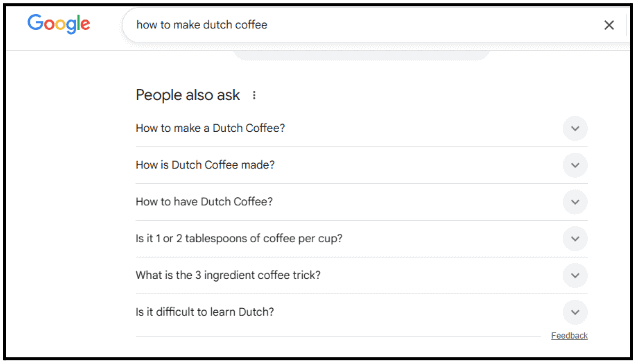
💡Pro Tip: Provide high-value information they can’t find anywhere else. Users might launch complex queries about Dutch Coffee that AI isn’t capable of understanding.
For example, “Will Scotch pair well with Dutch Coffee?” If you have experience with liquor, you might want to include a header that explains the “5 Best Liquors to Pair with Dutch Coffee.”
4. Prioritize Search Intent
Do you notice that AI provides you with the answer to your query right away?
For example, if you search:
“What is the best day of the week to visit Disneyland Anaheim with small crowds?”
You’ll see the following AIO summary:
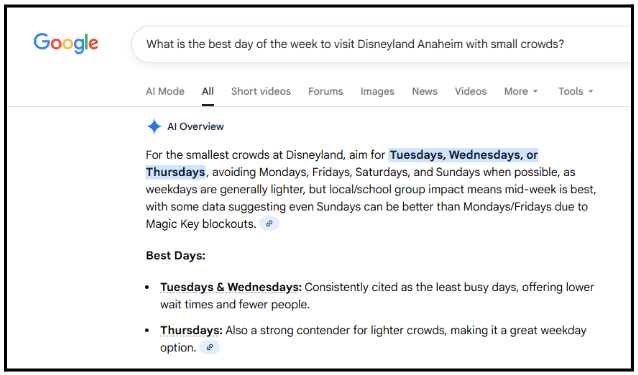
Do the same thing: Make search easier for the audience and AI, and provide the answer to the user’s query in your content right away.
How?
Let’s look at two different approaches by the websites referenced by AIO.
The first website, Disney Tourist Blog, provided the answer in the middle of the article:

(Source: Disney Tourist Blog)
The second website, Disneyland Resort, answered the search query in the second paragraph under the header, “Least Busy Days To Visit Disneyland”:
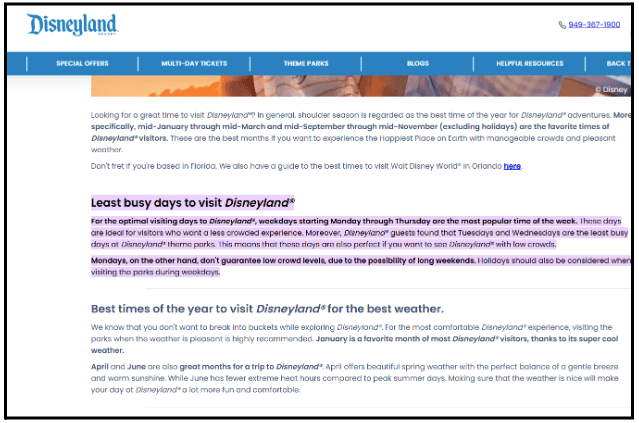
(Source: Disneyland Resort)
Why the difference?
Disney Tourist Blog is a personal blog and uses a storytelling approach (Like we suggested, “Humanize content”). The writer sets up the audience by narrating common mistakes people make when planning a visit to Disneyland.
Disneyland Resort is a business blog and takes a straightforward approach. In fact, the blog mentions the best months to visit Disneyland in the first paragraph.
We recommend taking Disneyland Resort’s approach: Respond to the query right away. If possible, provide the answer as the first sentence in the first paragraph, just like AIO.
If you’re unsure, contact us! We’ll do it for you!
5. Become Active on Online Community Platforms
Online community platforms like Reddit and Quora enable conversations with individuals who share similar interests.
Reddit is a popular data source for AI search tools.
In 2024, OpenAI entered into an agreement with Reddit to grant ChatGPT access to the social media site’s server and data software. The purpose is to use Reddit’s data as a training tool to better understand human interactions and conversations.
The “social” in social media is a reminder of the importance of building meaningful relationships with customers and followers.
Social humanizes business by creating a personality.
Here are four tips on staying active in social networks:
- Set up business pages in high-value social media platforms such as Facebook, LinkedIn, and Instagram.
- Build your community through daily postings of original and curated content, status updates, fresh blogs, short and long-form videos, live feed, static images, memes, and GIFs.
- Engage followers. Respond to comments. Share knowledge. Attend to chat messages. Interact responsibly, respectfully, and professionally.
- Social media networks host focus groups within various industries that frequently discuss topics relevant to your business.
Join relevant focus groups and actively participate in the discussions. Initiate or engage in topics that present opportunities to promote your business.
Online community platforms provide forums to start conversations that are valuable for AI search.
6. Enhance Local SEO Presence
Despite controlling 90.3% of the global search market, Google has invested heavily in AI technology. Google’s AI Overviews primarily use Google My Business (GMB) to learn about local businesses.
An up-to-date and accurate GMB profile provides AIO and other AI search tools with structured and reliable data to process, analyze, and answer local queries.
Local search is driven by strong user intent. Many people who search for local businesses “near me” have a buyer’s mindset.
That’s why the conversion rate from AI search is high – three times higher than other channels.
If your GMB profile appears in AIO, there’s a 76% probability that your physical store will receive visitors and a 20% chance the visit will result in a purchase.
Conclusion
The shift in search preference from keyword-based to conversational is a message from users urging a return to the fundamentals of effective communication: Clarity, accuracy, trust, and context.
Conversational search saves users time, reduces the risk of clicking poor-quality resources, and delivers accurate results, especially when handling complex queries.
SEO remains a valuable component of digital marketing, but it must evolve and adapt to the ever-changing search landscape.
Digital marketers and content creators must reevaluate and adjust current search engine-focused strategies to incorporate GEO principles, shifting their attention towards AI search visibility.
Conversational search isn’t a trend. It’s here to stay. As AI continues to evolve, it will reshape search as we head into the future.
Now’s the time to realign your digital marketing strategies with AI. Let’s book a call, and we’ll help prepare your business for conversational search.
Frequently Asked Questions
1. Do AI tools have features that protect my data?
Yes. AI tools have built-in features that can protect your data from theft. Examples of data protection features include encryption, an option for authorizing access, and limits on data usage.
We recommend reviewing the developer’s policies on data collection, usage, and retention.
2. Are there risks for using AI search tools?
Yes. The existence of malicious bots, false news, and deceptive content can “trick” AI into propagating misinformation. Accessing data with biased information can generate inaccurate results. Also, collecting large amounts of data makes AI an ideal target of hackers.