

If content is king, then in 2025 and beyond, the power behind the throne is AI technology.
Artificial Intelligence (AI) is a technology that enables computer systems to process, analyze, and perform tasks requiring human abilities such as reasoning, problem-solving, and decision-making.
AI technology encompasses machine learning, an innovation aimed at studying, understanding, and replicating human behavior. These are computer systems designed to think and function like humans.
Contrary to James Cameron’s vision, AI is not studying our behavior to empower robots to take over the human race.
For digital marketing, AI has proven invaluable in helping humans create amazing content and develop user-focused SEO strategies in the race for the top spot in the search rankings.
It’s best to understand the content creation process to appreciate AI’s value in SEO.
Let’s begin with a foundational piece of content creation: blogging.
How Long Does It Take To Write A Long-Form Blog?
According to SerpIQ, long-form blog posts with a minimum word count of 2,000 words are most likely to rank in the top 10 of Google’s search engine results pages (SERP).
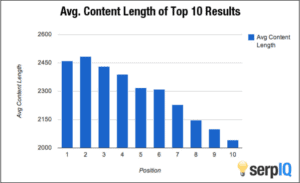
How do long-form blogs boost SEO?
- Comprehensive blogs allow you the time and space to share your knowledge and experience in greater detail. Google will view your content as providing useful and relevant information to users.
- Long-form blogs take time to read and will extend the users’ time on page. Longer time on page reduces your website’s bounce rate.
- A Backlinko study showed that long-form blogs generate an estimated 77% more backlinks and 56% greater social shares than short-form blogs.
The problem is that it takes time to create a 2,000-word blog.
As a digital ad agency, we provide blog writing services to our clients. From our experience, it takes our writers three to four hours to finish a long-form blog that ranges from 2,000 to 2,500 words.
Writers are humans. It’s unrealistic to expect writers to write for three to four hours straight. They’ll get tired, and lose focus, and the quality of writing will suffer.
Many writers will write for 60 to 90 minutes, then take a short 30-minute break to rest their minds.
So, if we were to break the four-hour writing process into 60/30 or 90/30 blocks, a 2,000 to 2,400-word blog would take six hours to complete.
That’s almost an entire workday!
It takes time to complete a blog because there’s a process to creating content.
What Is The Content Creation Process?
In a future article, we’ll do a deep dive into the content creation process. For now, here’s a simplified overview of what’s involved in content creation and how the process works.
1. Content Ideation:
- Identify your target audience.
- Find out the topics they’re interested in.
- Identify your goals – Brand building, increasing sales, improving sales conversion rate, generating leads, or enhancing reputation as an expert to name a few.
- Quantify your goals and align them to your content strategy.
- Choose the types of content you want to create – Blogs, videos, infographics, ebooks, newsletters, or product reviews.
2. Content Planning:
- Conduct keyword research.
- Create a topics list.
- Create a content brief per topic.
- Create a topic outline.
- Establish timelines for drafts, reviews, submissions, distribution, and publication.
3. Content Creation:
- Identify resources for topic research.
- Perform topic research where the goal is to become an “expert on the topic.”
- Prepare the preliminary drafts.
- Review the drafts for readability, usability, relevance, and intent.
- Add images, charts, and other graphics as necessary.
4. Quality Control:
- Evaluate content adherence to SEO principles by checking the quality of internal and external links, appropriate keyword usage, and the proper implementation of meta, title, and image tags.
Check for spelling and grammar errors. - Perform plagiarism tests.
5. Finalize Content:
- Implement improvements for SEO.
- Implement revisions to improve content quality.
6. Prepare Content for Publication and Distribution:
- Upload content on the website.
- Select the distribution channels.
- Upload the content of the proper distribution channel.
You don’t just write blogs.
You have to know what to write about and for whom. Likewise, you can be an accomplished creative writer, but no one will find your blog if your content doesn’t undergo optimization.
Finally, Google’s that teacher who knows you had the classroom genius write your term paper. You must ensure that your content is unique and free from plagiarism.
Writing a compelling blog takes time, but the results are worth it. The good news is that AI can speed up the content creation process.

How AI Technology Is Transforming The Content Creation Process
AI technology transforms content creation from a tedious and time-consuming process that suffers from redundancy overload to one that’s automated, productive, and efficient.
AI technology impacts each stage of the content creation process.
1. Content Ideation
- AI content creation software uses algorithms to scan, collect, process, and analyze data, helping you identify topics that interest your target market.
- AI technology has built-in analytics features that help you track the performance and engagement level of your content. You’ll know which content types and distribution channels are generating good ROI.
2. Content Planning, Publication, and Distribution
- Natural Language Processing (NLP) allows AI technology to analyze keywords for context and sentiment. In other words, not only will you receive a summary of trending keywords, but you’ll also gain insight into the intent behind the search.
- Uncovering the intent behind the keyword will help you align your content strategy with your business goals.
- AI can analyze topics and create outlines that organize ideas and guide creators in crafting content that is articulate, well-thought-out, useful, informative, and relevant.
- AI can automatically upload content on your website and key channels for immediate distribution.
3. Content Creation:
- AI can scour the Internet for the best, most credible resources you can use for topic research.
- Type a search query using ChatGPT, CoPilot, or Google’s Gemini. Within microseconds, you’ll have a well-written and thoroughly researched piece of content you can use as a reference for your blog.
- AI’s data-collecting power goes beyond analyzing text content. AI can scan the Internet for relevant images, graphics, and videos.
- NLP enables AI to recommend statistics and case studies that will make your content more valuable to users.
- Machine Learning models allow AI to suggest engaging and compelling Calls-to-Action (CTA).
4. Quality Control… and Content Finalization:
- Plagiarism, spelling and grammar checks can all be done by AI.
- Analyzing text for context, sentiment, language patterns, type, tone, format preferences, and style allows AI to propose improvements for coherence, readability, and personalization.
- AI can implement recommendations and enhance SEO.
💡AI Technology can be used as a hub; a centralized location where content creators can perform all functions of the process – ideation, planning, creation, quality control, publication, and distribution.
How AI Is Transforming SEO Strategies
As we’ve explained, AI can significantly improve the efficiency of content creation. Because content creation is a fundamental aspect of SEO, AI’s influence will surely shape SEO strategies.
1. Scale Content Marketing Strategy
Having the ability to scale your content marketing strategy is important because you can adjust the quality and production of content output as your market grows.
Here are reasons why AI helps you scale your content marketing strategy:
- Automate Processes: Create workflows that allow you to perform keyword research, topic research, write drafts, conduct QA checks, publish, and distribute content in various online channels.
- Enhance Content Quality: AI’s Machine Learning abilities allow it to study and understand human behavior and provide recommendations that can emphasize search intent, improve readability, and enhance user value.
- Identify High-Value Channels: AI can analyze user engagement levels and online behaviors across different platforms and networks. Realign your distribution strategy and promote content only through high-value channels.
If you can scale your content marketing strategy effectively, your SEO campaign can take advantage of growth opportunities and expand your market reach significantly.
2. Generate Higher ROI
Streamlining the content creation process while improving productivity will generate a higher ROI on your SEO efforts.
With AI technology, you can speed up the writing process. Repurpose the skills of your SEO team. For example, instead of employing two writers, delegate text/image editing work to one of them.
AI technology can analyze on-page SEO and implement improvements in meta descriptions, title tags, and internal linking structures. Meanwhile, the web developer can focus his attention on more complex aspects of technical SEO.
3. Create Personalized, User-Focused, and Intent-Driven Content
Google and search engines have grown smarter.
Embedding keywords in the title, first paragraph, the body of the text, and conclusion while maintaining a KW density of under 2% isn’t good enough anymore.
Google wants content to deliver on user intent. What are the underlying reasons or motivations behind the search?
The search engines’ shift toward delivering personalized, user-focused, and intent-driven content is a brutal rebuke to SEO experts trying to game the algorithm with keywords and links.
AI doesn’t just deliver high-ranking keywords. It analyzes and explains search intent to help you create user-focused content.
4. Enhance Website UX
The content you’ve created, published, and distributed has triggered an influx of website visitors. You can’t let your efforts go to waste by presenting visitors with a website that delivers an underwhelming User Experience (UX).
Chatbots are by-products of AI technology that can greatly enhance website UX. Think of a chatbot as the store clerk who approaches and asks, “Do you need help?”
If you are managing an e-commerce platform, an AI can study the online behavior of users and provide them with personalized content.
For example, a user who routinely navigates your clothing online store for running gear will be presented with suggestions on running shoes, apparel, and training equipment.
5. Augment the SEO Skillset
What hard skills are typically required of SEO specialists?
- Website Development
- Understanding of HTML, JavaScript, and CSS languages.
- Keyword Research
- Website and Social Media Performance Analytics
- Content Writing
- Text/Image/Video Editing
- Link Building
- Page Speed Optimization
- On-Page and Off-Page SEO Tactics
Add “AI Software Technology” to the list.
Hiring managers will ask SEO specialists if they know how to use ChatGPT for keyword research, topic research, content creation, and optimization. To be competitive, relevant, and top-of-mind in the SEO industry, you must be proficient in using AI technology for SEO.
Conclusion
AI saves time and money, increases productivity, effectively scales marketing efforts, helps you meet timelines, and improves the probability of hitting business goals.
Incorporating AI technology will introduce efficiency in your content creation process and enhance your SEO strategy.
However…
Remember, AI is Machine Learning technology. AI’s programmed to learn human behavior but it is still a machine incapable of empathy and fully understanding context.
If you’ve used Grammarly, you may notice some recommendations that stray from context.
For example, this section from our introduction might confuse Grammarly:
“Contrary to James Cameron’s vision, AI is not studying our behavior to empower robots to take over the human race.
“For digital marketing, AI has proven invaluable in helping humans create amazing content and develop user-focused SEO strategies in the race for the top spot in the search rankings.”
Grammarly might not understand the reference to Cameron’s movie “The Terminator” and recommend a more straightforward statement:
“AI is an invaluable tool in helping you create amazing content and user-focused strategies that can boost your search rankings.”
There’s nothing grammatically wrong with the sentence. However, the Terminator reference gives the section a nice human touch that will resonate with readers.
Likewise, alluding to Snapchat’s AI, failure to properly understand context might lead AI to make erroneous or inappropriate recommendations.
Thus, be careful when using AI. Exercise human judgment when finalizing content.
If you’re impressed with our content, contact us. We can develop a results-driven, AI-powered SEO strategy for you!