
In recent years, websites have experienced a decline in search traffic. As a consequence, a new crisis came about.
Zero clickthroughs.
Page one rankings aren’t spared.
Websites that achieve the highly sought-after page one rankings are receiving less traffic and experiencing a decline in click-through rates.
No clicks, no website visits.
No website visits, no conversions.
No conversions, no business.
The culprit?
Artificial Intelligence.
The accomplice?
Google.
Yes, Google, the search engine giant that developed the ranking algorithm SEO practitioners closely follow, contributed to the decline in traditional search traffic when it incorporated AI search in its platform.
Is Google shooting itself in the foot?
No.
Google embraces innovation and recognizes that AI has influenced user behavior.
Users were increasingly favoring detailed, conversational queries because these produced accurate and comprehensive responses compared to traditional keyword-based search results.
Enhancing its search feature with generative AI capabilities allowed Google to better adapt to changing users’ search preferences and continue to ensure them of an excellent experience.
Therefore, investing in AI technology was the logical next step for Google.
Like Google, we recognize that the future of search is conversational. Google is preparing for the future, and so should you.
However, we cannot disregard the importance of ranking in Google search.
In this article, we’ll explain why and how we’re helping businesses rank in both Google and AI search.
Let’s start with the why.
Why Your Business Needs To Rank In Both Google And AI Search
As influential as AI has become, traditional search remains a key component in achieving online success.
Here are five reasons why your business should rank in both Google and AI search.
1. Google Is Still the King of Search
Google controls 90.83% of the global search market.
ChatGPT, the leading AI search tool, holds only 0.31% of the global search market.
Ranking in Google, particularly on the first page of the SERP, helps enhance brand visibility and credibility through increased impressions.
Impressions are the number of times your website link appears in a user’s search results. The first page of Google’s SERP receives more than 90% of views. Hardly anyone goes to page two.
What does that mean for your website?
If you land on page one of the SERP, you get all of the impressions.
Rankings don’t matter because users will see the websites that are listed on Google’s most important page.
Users might not click, but they see. Some will get to read your meta descriptions.
They recognize.
That’s brand visibility.
💡Key Takeaway: Google remains the largest and most powerful search engine in the world. Google has acquired more than 200 companies, including YouTube, Zingku, Outride, Orion, and Waze, to further expand its reach and scope of services.
Maintaining your presence in Google’s search rankings can help increase brand visibility on its other platforms through ads and new market exposure.
2. Not All Queries Generate an AI Summary
A 2025 Pew Research Center study showed that only 18% of search queries generated an AI summary.
Queries are categorized based on intent.
- Informational: User seeks an answer to a question, but has no intention to transact.
Examples: “How to lose weight,” “What does IIoT mean?” and “Why is flossing important?”
- Navigational: User intends to find a specific brand, website, or web page.
Examples: “Netflix,” “Amazon,” and “Nike.”
- Commercial: User has an intention to transact or conduct research before transacting.
Examples: “Samsung Galaxy vs iPhone,” “Saucony Kinvara Pro running shoes,” or “Fitbit Versa 3 review.”
- Transactional: User has a strong willingness to take immediate action, such as purchasing a product, subscribing to a service, or downloading content.
Examples: “Buy 20 watt guitar amp on sale,” “order birria tacos delivery,” or “download travel ebook.”
Which type of query produced the highest percentage of AI summaries?
| Type of Query: | Percentage: |
| Informational | 97.70% |
| Commercial | 12.86% |
| Transactional | 2.85% |
| Navigational | 1.23% |
💡Key Takeaway: If a query doesn’t produce an AI summary, users will scroll to the search rankings to get answers.
3. The Growth of AI Is Undeniable
AI accounts for less than 1% of searches today.
Tomorrow?
Research firm Gartner believes that this year, 2026, traditional search engines will lose 25% of their share of the global search market to AI chatbots.
SEO agency Morning Score estimates that AI tools will reduce Google’s share of the global search market by 14.2% in 2028.
Aside from changing user behavior, two other factors, technological advances and diversified market needs, are fueling AI’s growth.
- Technological Advances: Presently, commercial, transactional, and navigational queries hardly generate AI summaries because the Language Learning Models (LLMs) running AI technology aren’t fully capable of understanding context.
Ultimately, LLMs and their Natural Language Processing (NLP) and Machine Learning (ML) programs will advance technologically to the point where they can analyze queries and provide more accurate, relevant, and contextually aware results.
- Diversified Industry Needs: AI technology can customize its search capabilities to fit the needs of specific industries.
For example, businesses in the legal industry cater to a different market than those engaged in retail or e-commerce.
💡Key Takeaway: In one to three years, 75% of Google searches may produce an AI summary.
Why wait?
4. Brand Visibility Is a Must
YouTube ads are annoying, right?
This isn’t our opinion.
According to Statista, 42% of users are annoyed by online ads.
So if online ads negatively impact user experience, why do platforms such as YouTube, Facebook, and Google constantly bombard users with them?
Impressions.
You can skip them after five to 25 seconds, but the ad has already created an impression.
In the world of advertising, there’s no distinction between a bad or good ad impression. It won’t matter to these companies if you need their product or not.
Their brand has been embedded in your consciousness.
On your next trip to the supermarket, and if you’re looking for a brand of olive oil to buy, you’ll reach out for a particular logo that you recognize. It doesn’t matter how or why you recognize the logo.
What matters is that the brand made an impression on you.
Advertising on YouTube enables businesses to reach 32% of the global population.
That’s almost three billion people.
Three billion impressions.
That’s the power of brand visibility.
Google has reported that 70% of consumers bought a product after seeing the ad on YouTube.
An AI mention in a summary can boost your business brand further than website traffic alone.
💡Key Takeaway: Fundamental SEO practices can help improve brand visibility and get your brand mentioned by AI.
5. Improve Your Conversion Rate
Less than 1% of users click on links cited in the AI summary, but anyone who clicks them is further down the sales funnel.
It’s aligned with a consumer’s normal purchase journey.
A user will move from being an interested consumer to a potential customer if the AI summary convinces them that the brands mentioned offer the best answer or solution to their search query.
Website traffic and clickthrough rates might be down, but conversion rates are higher if your brand is mentioned or cited in the AI summary.
How much higher?
A study by Microsoft revealed that AI search’s conversion rate is three times higher than traditional search, direct referrals, and social media.
💡Key Takeaway: AI has led to a decline in web traffic and CTRs. However, AI has improved conversion rates.
By realigning your resources and targeting both Google and AI rankings, you can capitalize on new opportunities created by AI search.
What Are The Differences Between SEO And GEO?
To understand how we’re helping businesses rank in both Google and AI, we need to discuss two optimization processes: SEO and GEO.
- Search Engine Optimization (SEO): The process of enhancing web page visibility to search engines by optimizing content to align with the search ranking algorithm.
- Generative Engine Optimization (GEO): The process of enhancing brand visibility to AI search by optimizing content structure, clarity, authoritativeness, trust signals, and third-party mentions.
Let’s find out the key differences and similarities between SEO and GEO.
1. 6 Key Differences Between SEO and GEO
| Feature: | SEO | GEO |
| Target Platform | Search Engines | Artificial Intelligence |
| Objective | Increase traffic to websites | Increase brand mentions |
| Results | Produce a summary of links that are relevant to the search query | Provide brand mentions that directly answer the search query |
| Key Metric | Clicks | Visibility |
| Search Phrasing | Keyword-based | Conversational |
| Qualifying/Ranking Factors | Adherence to the algorithm’s search ranking factors: Keywords, backlinks, and metadata. | Content quality, readability, structure, and relevance to the search query. |
SEO aims to improve your visibility to search engine crawl bots, allowing them to find and index your webpage for the SERP.
Web pages are listed based on their adherence to the algorithm’s various ranking factors that include keyword usage, content quality, on-page structure, backlinks, technical aspects, and user experience.
Keywords are the basis for performing search queries.
For example, if you want to learn how to bake a Basque cheesecake, as you’re typing the keywords “basque cheesecake,” Google will list its search recommendations.
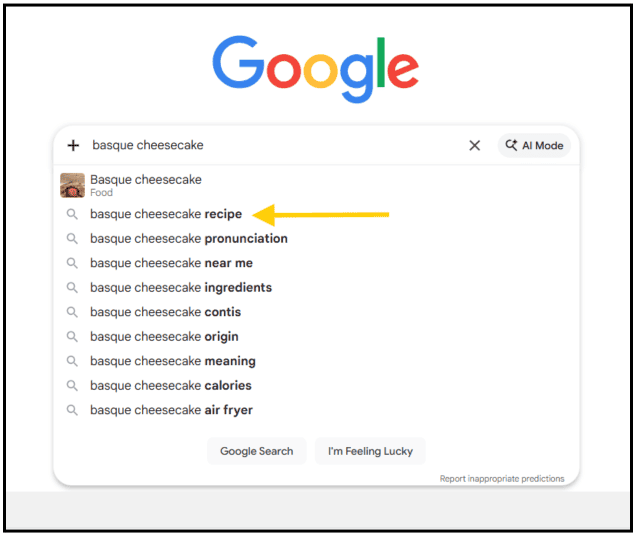
Click “basque cheesecake recipe.”
You’ll see an SERP with a list of web pages ranked by Google’s algorithm:
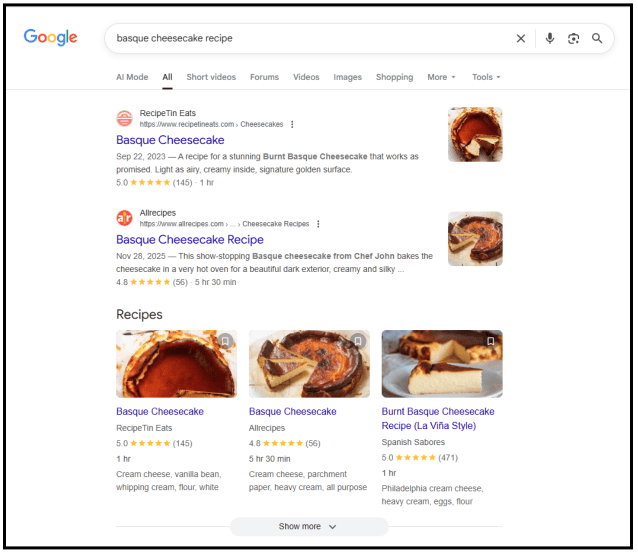
If you click “Show more,” you’ll be presented with additional web pages to consider.
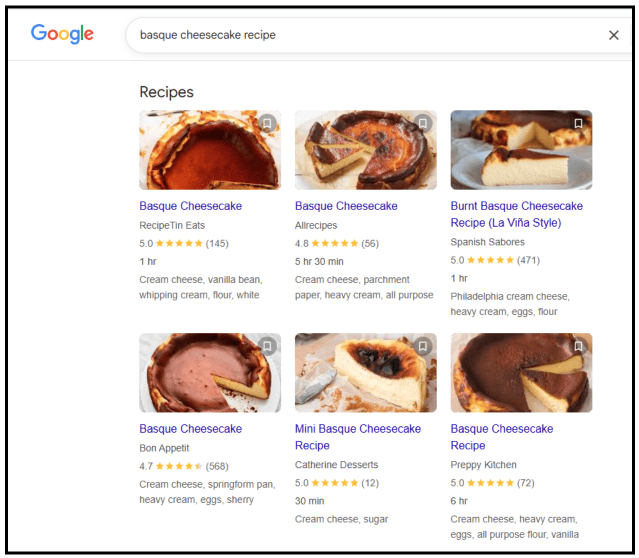
Scroll further, and you’ll see more website links that are relevant to your search query.
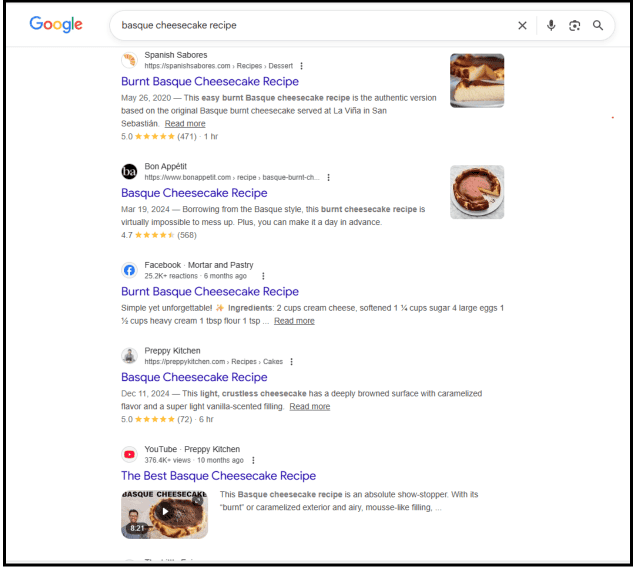
So many choices to choose from!
Which one will you click?
According to Backlinko, the first position on the SERP gets 27.6% of clicks, and it’s 10-times more likely to get a click compared to the web page listed on the tenth position.
It’s a good guess that the first web page you’ll click is “RecipeTin Eats.”
The question is:
Does the “RecipeTin Eats” web page provide the best recipe for Basque Cheesecake?
In contrast to SEO, GEO’s focus is to get your brand mentioned or cited in the AI summary.
How do you accomplish this objective?
AI utilizes complex Large Language Model (LLM) programs that incorporate Machine Learning (ML) and Natural Language Processing (NLP) technologies.
The AI creates a contextual summary response based on its understanding of the available data.
You want AI to recognize, study, and analyze your content as a valuable resource so it can mention or cite your brand in its summary.
To generate an AI summary, type an informal query:
“How to bake a Basque Cheesecake.”
Google’s AI Overview (AIO) will produce the following summary:
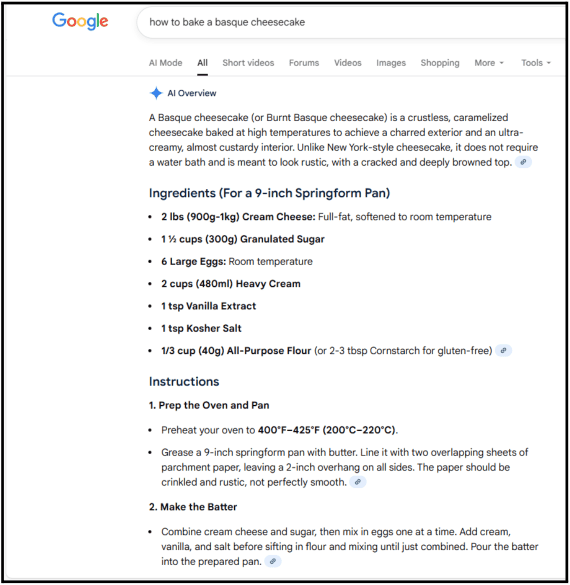
The AI summary provides all the information the user needs to learn how to bake a Basque cheesecake.
The links to the sources used by the AI to process the contextual response are included in the summary:
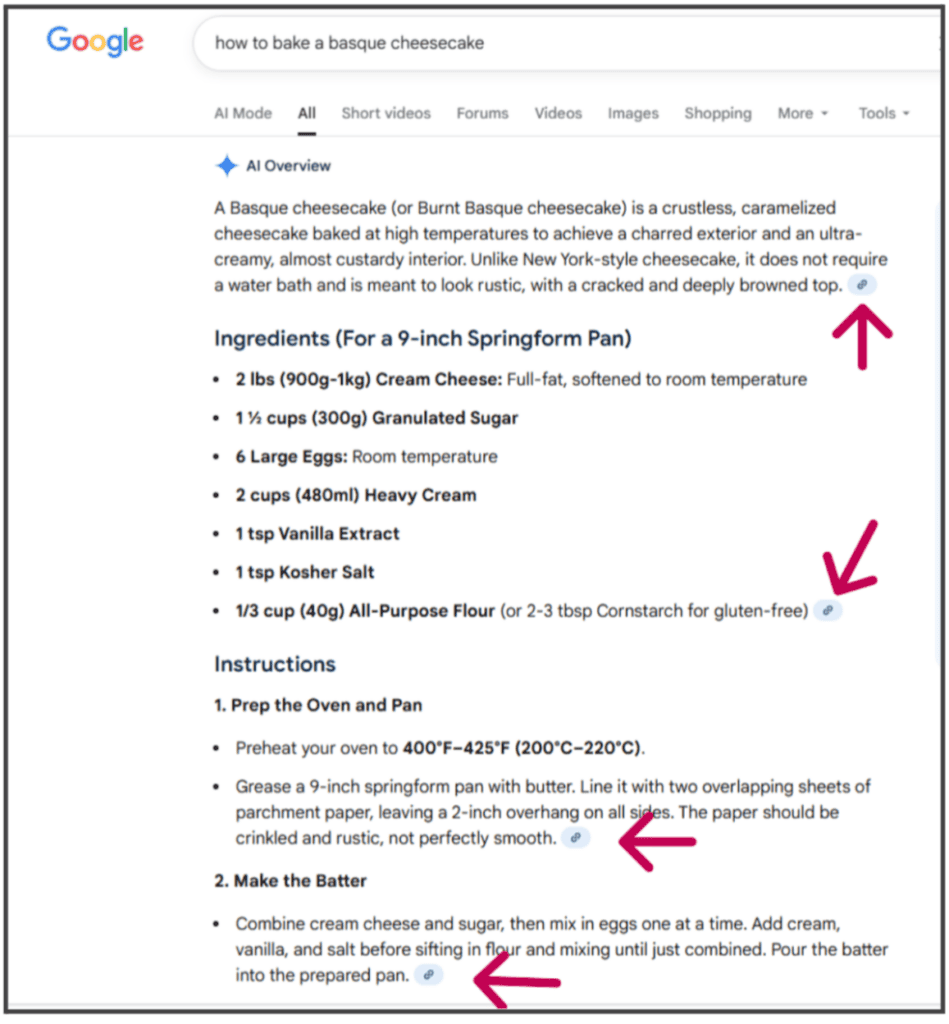
If you scroll down, you’ll see the same SERP we presented earlier.
What will the user do?
According to data:
- 26% will end their search after reading the AI summary.
- Less than 1% will click on a link cited by the AI summary.
- 8% will scroll down to the traditional search results.
In the real world, humans are a patient lot.
Online is a different story.
Our attention span online is only 8.25 seconds, down from 9.20 seconds in 2022. We spend an average of 1.7 seconds reading a piece of content before deciding to engage or scroll past.
An AI summary is more aligned with human behavior than traditional search results.
You have the answer you need, and it’s located at the top of the SERP before the traditional search results.
Unless the search query doesn’t produce an AI result, users won’t have the motivation to scroll down and see the traditional search rankings.
💡Key Takeaway: As influential as an AI summary is, the technology is still developing and improving its capacity to understand context. You still need to show up in Google’s traditional search rankings.
2. The 5 Key Similarities Between SEO And GEO
| Feature: | Implementation for SEO and GEO |
| Keyword Usage | High-ranking keywords are incorporated into the content, but they should not compromise the conversational flow of natural human language. |
| Content Quality | Follows Google’s E-E-A-T guideline: Expertise, Experience, Authoritativeness, and Trustworthiness. |
| User Intent | Content must provide users with answers that best address their intent. |
| Authority and Trust Signals | Link only to authoritative and trustworthy sources. |
| Effectively Designed Website | Websites that are mobile responsive, fast, navigable, optimized for search and AI, and 100% functional ensure users of an excellent experience. |
As you can see, both disciplines share features that are essential components for enhancing online visibility, brand reputation, and user experience.
Integrating both processes into one comprehensive digital marketing strategy isn’t complicated.
We view incorporating GEO practices as an upgrade to SEO because you’re adding more detail, tightening up quality control, and expanding your audience to include AI.
GEO will enhance SEO.
Allow us to explain further.
- Keyword Usage: Keywords must not be forced into the content for the sake of complying with the search engine algorithm. They must be used naturally without compromising clarity, accessibility, and readability.
- Content Quality: Provide users with well-researched and up-to-date information that comprehensively answers their queries. Substantiate the information with statistics, charts, graphs, and other forms of empirical data.
- User Intent: Some websites implement posturing tactics designed to keep users on the page longer. You have to scroll more than 1,000 words before you get the answer to your query.
Don’t do this. Provide the answer to the queries immediately. If possible, the answer should be found in the first paragraph.
You can use the rest of the article to cover topics that are relevant to the search query and offer users greater value. - Authority and Trust Signals: In addition to content quality, AI also favors information that’s linked to authoritative and trustworthy sites.
By citing reputable sources, AI protects users from accessing websites that have inadequate information and are corrupted by black hat practices.
Black hat practices are deceptive tactics designed to manipulate the search rankings.
Examples of black hat practices are keyword stuffing, cloaking, link farming, adding invisible links, and buying links from malicious websites. - Effectively Designed Website: If your website isn’t designed properly, AI and search engines can’t access and analyze its content correctly. Your SEO and GEO strategies will fail.
If users decide to click on AI citations or the search results, you want to assure them of an excellent experience.
That means a mobile-responsive website with pages that download within three seconds, excellent navigability, and fully-functioning features.
We’ll go into more detail in the next section when we put everything together and come up with a comprehensive optimization game plan.
Our Step-By-Step Guide On How To Rank In Both Google And AI
Now that you know the differences and similarities between SEO and GEO, we’ll explain how we can help your business rank in both Google and AI.
Step 1: Invest In A Website
As AI increases its influence over user behavior, website traffic, and clickthrough rates are expected to continue their decline.
Thus, brand visibility has become a more crucial factor.
The website is the digital representation of your business brand on the Internet. It’s a brand ambassador that promotes your business to a global audience 24/7 and 365 days a year.
Everything that users need to know about your brand is on your website:
- Unique Value Proposition (UVP).
- Core Values, Purpose, and Vision.
- Mission Statement.
- Business history.
- Products and Services.
- Social proof.
A website professionalizes your business and establishes its identity in the industry.
Owning a domain name is proof you’re invested in your brand. Sending emails with a “gmail.com” domain suffix is a thing of the past because you have a personalized webmail address.
The website is your online hub of business operations and handles different areas of responsibility:
- Marketing
- Sales
- Customer Support
- Research
- Logistics
- Communication
Without a website, you can’t establish an online brand identity.
If you don’t have a website, contact us. We’ll build one that’s optimized for search engines and AI.
Step 2: Create Optimized Content
SEO and GEO depend on high-quality content that effectively addresses users’ queries. The difference is how the response is delivered to users.
SEO delivers links while GEO creates a comprehensive summary with brand mentions and citations.
Our strategy for content creation includes key elements and techniques that improve visibility for both search engines and AI.
- Keywords Usage: Our focus is to fit high-ranking keywords naturally without affecting context and the conversational tone of natural human language.
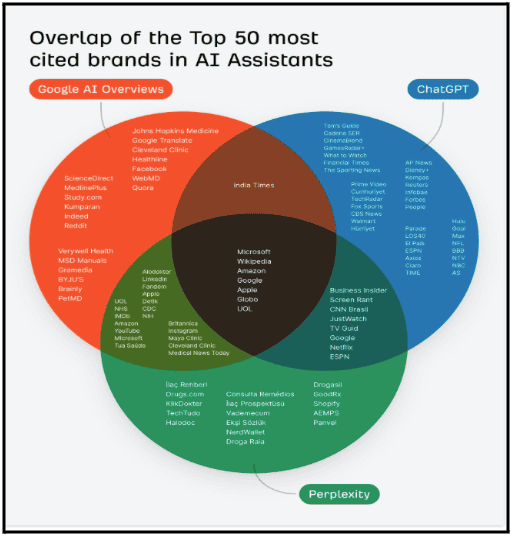
- Topic Research: We prioritize reputable sources that are recognized as authoritative and trustworthy sites.
Ahrefs created an infographic of AI’s most cited sources:
(Source: Ahrefs) - Quality: Follow Google’s E-E-A-T guide for content quality. E-E-A-T stands for Expertise, Experience, Authoritativeness, and Trustworthiness.
In addition to providing comprehensive information sourced from credible sources, include relevant personal experiences that users and AI can learn from.
For example, share a particular situation that users can relate to and explain how you were able to resolve it. - Structure: Content is structured to enhance readability. We utilize headers, bullet points, and emphasize key sections with highlights, emoticons, and borders. Paragraphs and sentences are kept short for easier scrolling.
- User Intent: We aspire to give users the best answer to their search queries… and more. We’re constantly thinking, “What other types of information does our audience need that are relevant to their original query?”
We also include an FAQ section that provides brief answers to questions the audience may have.
The end product is long-form content that provides more information than users expected. Long-form content not only improves search rankings but also establishes our credibility as industry experts. - Conversational Tone: For AI, understanding human context is still a work in progress. You want to make the learning process easier for AI.
Writing in a conversational tone not only makes content clear and readable, but it also replicates natural human language.
Also, some of the headers are written in question format, which is how users phrase informational queries.
Step 3: Build Your Business Brand
Be visible to AI by staying active online.
- Open a Google My Business (GMB) page. Frequently update your information, and try to post new content monthly.
- If you qualify, create a Wikipedia page for your business.
- Create various types of content: Long/short form blogs, long-form videos, reels, infographics, informational e-books, webinars, quizzes, memes, live feed, and podcasts.
- Seek guest blogging arrangements with relevant industry websites and share your knowledge with the community. Post frequently on social media. If you can post from Monday to Friday, go for it!
- Actively engage with your followers on social media and other community platforms.
- Invite followers to give their reviews, ratings, and comments about your products and services.
- Join community forums that are relevant to your industry. Actively engage in discussions. Reddit is an essential community forum. OpenAI entered into a partnership with Reddit to allow ChatGPT to access the forum’s databases.
- Join interest or industry groups on social media platforms, especially LinkedIn.
- Contract the services of an influencer so you can leverage the size and reach of their market.
Step 4: Highlight Social Proof
If you’ve secured social proof, such as customer testimonials, positive reviews, favorable comments, five-star ratings, third-party or influencer recommendations, awards, and citations, let’s highlight them on your website and social media platforms.
We can include social proof on your home page, which is where users land when they click your link.
Another option is to create a separate and distinct testimonial web page and include the link to your other online platforms, social media, and GMB profile.
With the customer’s permission, create case studies on how your business helped them resolve specific issues. Share the results, complete with actual data, in your blogs and videos.
Step 5: Measure Performance
The Key Performance Indicators for SEO and GEO are different.
Below is a table summarizing the seven essential KPIs for SEO and GEO.
| SEO | GEO |
| Organic Conversions | Brand Visibility Score |
| Search Visibility | Brand Mention Share |
| Organic Traffic | Topical Visibility |
| Click-Through Rate (CTR) | Prompt-level Visibility |
| Keyword Rankings | Domain Influence |
|
Backlink Metrics:
|
Sentiment Distribution |
|
User Engagement Metrics:
|
AI Traffic |
The key takeaway is to evaluate your digital marketing campaign’s performance on both search engines and AI search platforms because SEO and GEO track different goals.
- SEO tracks your website’s performance in the search rankings by measuring business outcomes and user engagement.
- GEO evaluates the frequency and accuracy of brand mentions in the AI summary, along with user perceptions.
In another article, we’ll do an in-depth breakdown of the differences between SEO and GEO KPIs.
Conclusion
The increasing popularity of AI tools like ChatGPT, Perplexity, and DeepSeek was a signal to Google of a clear shift in search preferences from keyword-based to conversational.
Rather than fight change, Google chose to adapt to AI.
Expanding its search platform to include AI search allowed Google to fulfill its commitment to provide users with an excellent experience.
With AIO, users get an immediate response to their search queries. The response is conveniently presented as a comprehensive summary, complete with brand mentions and citations.
Likewise, appearing in AI summaries helped websites overcome the pitfalls of declining website traffic and CTRs through brand mentions, citations, and ad impressions.
If Google, the biggest search engine in the world and a company worth $3.98 trillion, adapted to AI, so should you.
Ranking in Google and AI search will enable your business to capitalize on opportunities presented by both platforms.
Incorporating GEO into your SEO strategy is straightforward. Think of it as upgrading your SEO strategy by adding more detail and shifting focus from search engines to AI.
You’re no longer just a creator. You’re a teacher.
Let’s get started!
Frequently Asked Questions (FAQs)
1. Does Google penalize AI-generated content?
No. Google doesn’t penalize AI-generated content. Google will penalize low-quality content that presents irrelevant, outdated, and unusable information. Google will also penalize web pages that utilize black hat tactics to manipulate search rankings.
2. Are the results of AIO accurate?
No. Google compares the accuracy of AIO with its featured snippets. AI pulls data from various sources and is at risk of studying outdated or erroneous information, particularly on health, medical, and financial topics. Therefore, it’s a good idea to click the citations and verify the information.