

Finding the right content topics can feel overwhelming. You want to create content about topics that attract traffic, rank on search engines, respond to popular user queries, and remain relevant for months (or even years).
Oftentimes, the search leads you back to where you started – a blank screen.
Here’s the good news: Relevant content topics for any audience are everywhere.
In this guide, we’ll show you exactly how to find content topics that are:
- SEO-friendly
- AI-visible
- Audience-focused
- Conversion-driven
- Sustainable for long-term growth
Whether you’re a blogger, business owner, freelance writer, or digital marketer, our step-by-step framework will help you consistently generate high-quality content ideas that will enhance AI and Google visibility.
Why Is It Important To Find The Right Content Topic?
According to a study by Ahrefs, 96.55% of content doesn’t receive Google traffic.
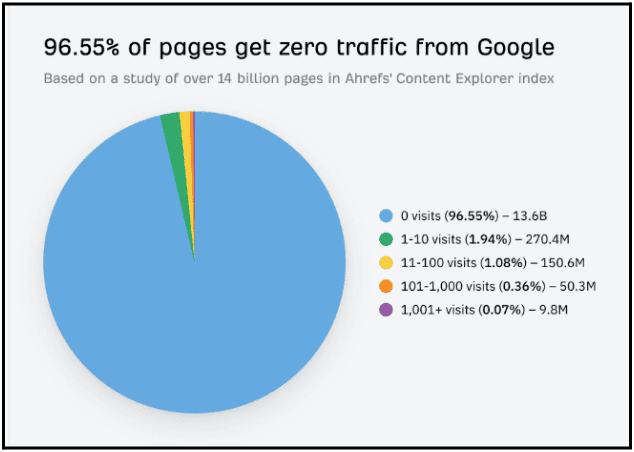
(Source: Ahrefs)
The number one reason?
The topic has no interest.
Even if your content ranks number one in Google’s SERP, if there’s no interest from an audience, it won’t generate search traffic.
AI systems will not reference it because there are no search queries related to it.
For a topic to be searchable by Google and AI, it must have three qualities:
- The topic matches the user’s search intent.
- The topic solves a real problem.
- The topic has backlinks.
Creating content on topics that fail to generate interest is a waste of time and resources. You won’t connect with your audience if the topics are either too broad or too competitive, and weak topics do not convert.
Therefore, if you struggle with poor traffic and low engagement, the issue often starts with topic selection.
So, where do you start?
A Step-By-Step Guide To Finding The Right Content Topics
The starting point for finding content topics is your audience.
Step 1: Start With Your Audience’s Problems
The golden rule for creating content is to create for your audience, not for yourself.
There’s no point in creating content no one searches for. Users are searching the Internet daily for valuable answers to pressing questions, actionable solutions to problems, and up-to-date information that fulfills their curiosity.
- What challenges does my audience encounter?
- What problems do they face?
- What keeps them up at night?
- What information could I provide that would make their lives easier?
You can uncover these questions from various sources:
- The comments section in your social media posts.
- Customer/user inquiries in your emails and direct messages.
- Responses to email or social media surveys.
- The social media pages of your competitors.
- Reviews of your products and services, as well as those of your competitors.
- Actively participate in social media interest group discussions.
- Google’s “People Also Ask (PAA)” section.
- Community platforms such as Reddit.
For instance, a frozen food products business would develop content topics that address the following questions:
- “How long can frozen food last in the freezer?”
- “What are the advantages of vacuum-sealing and freezing food?”
- “How can stocking up on pre-packed frozen food help me save money?”
- “Is it cheaper to heat pre-packed frozen food than dining out?”
- “Does frozen food retain its flavor?”
Writing about popular topics attracts more traffic and builds trust, establishing authority for your brand, which is essential for increasing AI visibility.
Step 2: Take a Strategic Approach to Keyword Research
Keyword research is an essential component of SEO. The process helps validate whether a topic has search demand.
The mistake people make with keyword research is chasing high-volume keywords without considering two important factors: search intent and competition.
1. Type of Search Intent
Ask yourself:
“What is the goal of the content I plan to create?”
Choose keywords that align with your content goals.
| Search Intent: | Goal: | Examples of Keywords: | Examples of Topics: |
| Informational | Provide users with valuable information. | “Find content topics AI Google.” | “How to Find Content Topics That Will Enhance AI and Google Visibility.” |
| Navigational | Direct users to a specific destination or web page. | “Facebook Meta” | “Why is Facebook Meta Important For Business?” |
| Transactional | Compel users to complete an action. | “Buy frozen meals online.” | “Where To Find And Buy Frozen Meals Online.” |
| Commercial | Assist users who are conducting research before taking a specific action. | “Best frozen food sellers.” | “How To Qualify The Best Frozen Food Sellers Online.” |
2. Competition
A long-tail keyword is a highly specific search phrase that’s usually composed of three words or more and targets a narrow audience with clear intent. The topic examples we used in the previous section are examples of long-tail keywords.
Short-tail keywords, consisting of one to three words, encompass broader search parameters and tend to have higher competition and search volume.
| Long-Tail Keywords | Short-Tail Keywords |
| “How to Find Content Topics That Will Enhance AI and Google Visibility.” | “Content topics” |
| “Why is Facebook Meta Important For Business?” | “Facebook Meta” |
| “Where To Find And Buy Frozen Meals Online.” | “Frozen meals” |
| “How To Qualify The Best Frozen Food Sellers Online.” | “Best frozen food” |
Long-tail keywords are effective for content marketing because they have less competition, convert better, and rank faster than short-tail keywords.
“Wait! Why did you use the entries under ‘examples of topics’ instead of ‘examples of keywords’ as your examples of long-term keywords?”
Great question!
The answer in two words.
Conversational search.
For optimal results in AI summaries, queries should be phrased in conversational language. This is because the AI’s Large Language Models (LLMs) analyze queries and generate contextual responses.

Step 3: Analyze the High-Ranking Topics
Run a Google search using each one of the keywords.
Here, we did a Google search using the conversational query “How to find content topics that will enhance AI and Google visibility.”
The first item you’ll see on the page is AI Overview, which provides an immediate response that includes links to websites it used to create the summary.
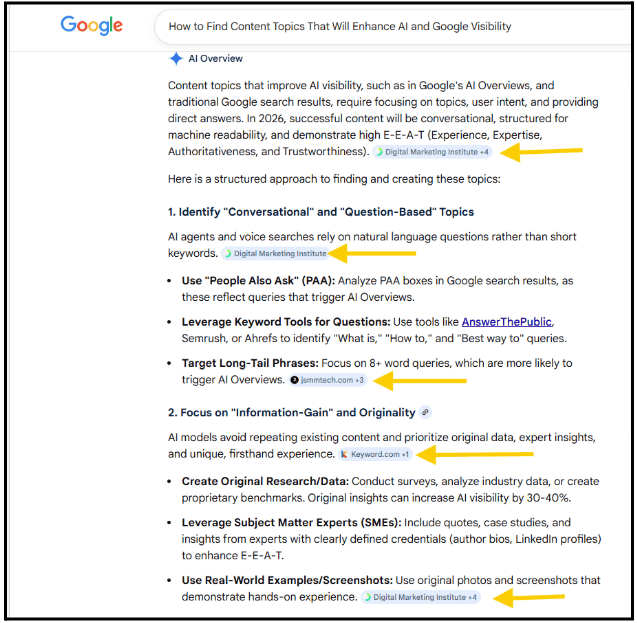
💡Pro Tip: Our search is an example of a query with informational intent.
97.7% of informational-type queries generate an AIO. To increase the chances of appearing in AIO, select topics that respond to informational queries.
Let’s go back to step #2…
On the right side of the summary, you’ll see a list of websites that discuss topics similar to our original query.
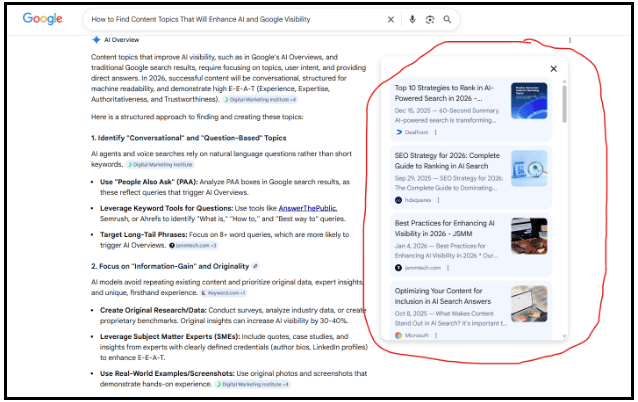
Scroll down, and you’ll see the traditional search results, which show the top-ranking web pages about the topic.
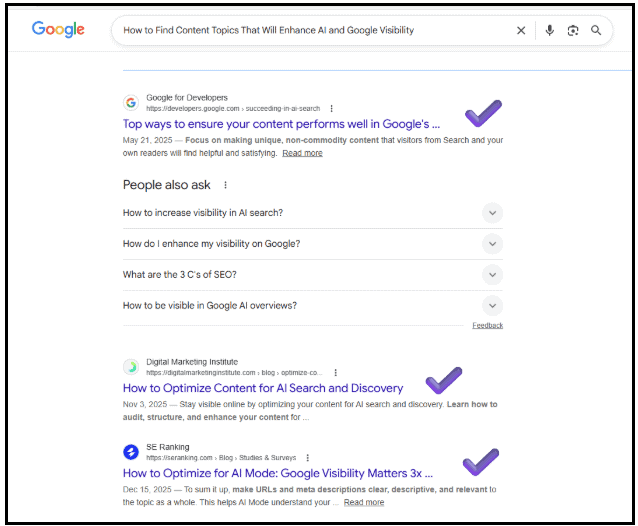
Click and analyze the content of the first three to five links in AIO and traditional search results.
- What are their headers?
- What subtopics are included?
- What subtopics aren’t included?
- What are the differences and similarities between these resources?
- Which ones do you believe align with the needs of your audience?
- Do any of the links discuss sub-topics that can stand alone as a primary topic?
- What questions are asked?
- How long are the articles?
- Which format is ranking high – listicle, guides, videos, or product reviews?
Analyzing the top five web pages will give you insights into what topics your target audience is searching for and how Google is ranking content.
You’ll notice that a different section appears between the first and second websites.
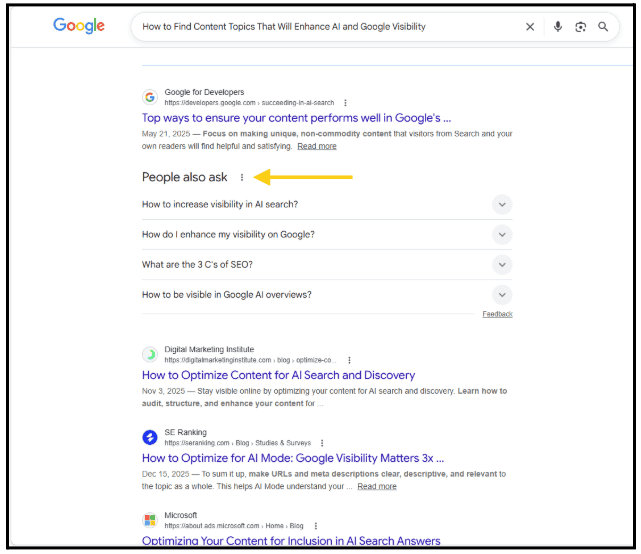
People Also Ask (PAA) is a Google feature that shows relevant topics users are searching for. If these recommendations fit your content strategy, consider adding them to your topic list.
To AI or Not to AI? That is the Question!Some of you might be wondering, “AIO already created the summary to your informational query? Why didn’t you just use the summary to create this article? You would’ve saved time and money.” Using AI to create content is always an available option, but we chose not to for a number of reasons. 1. AI isn’t accurate…yet. Its LLMs continue to struggle with analyzing context. Also, AI might be learning from outdated data. It might cite inaccurate links and information. 2. AI cannot replicate the human voice. One thing we tell our writers is to “write with their voice.” Doing so humanizes content and creates empathy, which is important to establish a connection with our audience. 3. AI falls short on Google’s E-E-A-T guideline. E-E-A-T is the acronym for Expertise, Experience, Authoritativeness, and Trustworthiness. AI’s learning systems deliver on Expertise, Authoritativeness, and Trustworthiness, but fall short on Experience. Sure, AI can learn from the experiences of others, but creating our own content allows us to share with readers experiences that are proprietary to Mountaintop Web Design. Proprietary experiences refer to real-world situations or problems our team faced that are relevant to the query, and how we resolved them. You won’t find some of our information anywhere else! Lastly, we don’t want to shortchange you. We appreciate your choosing our page and want to ensure that reading our article is worth your valuable time. |
Step 4: Create a Content Pillar
A content pillar identifies the main core topics and outlines the possible topics you can create from them.
For example, a frozen food business could have the following core topics:
- Meal prep
- Food storage
- Busy lifestyle cooking
- Budget-friendly meals
Its content pillar would look like this:
| Meal Prep | Food Storage | Busy Lifestyle Cooking | Budget-friendly Meals |
| How to Meal Prep for Beginners | 10 Benefits of Vacuum-Sealing and Freezing Food | 10 Best Ways to Cook at Home for the Busybody | 15 Practical Ways to Eat Healthy On a Budget |
| A Step-by-Step Guide on Meal Prepping for Office Workers | How to Store Food Properly | How to Make A One- Week Meal Plan If You’re Working 9 to 5 | Why Frozen Food Is Your Best Budget Solution |
| 12 Work-From-Home Meal Prepping Tips | What Are the Best Containers for Food Storage? | How To Make Healthy Eating Part of Your Busy Lifestyle | 5 Reasons Why It’s Better To Eat Frozen Food Than To Eat Out |
A content pillar organizes your content marketing strategy by keeping you focused on relevant, in-demand topics in your niche. It creates a strong internal linking strategy, strengthens your brand as an authority, and boosts AI’s understanding of your expertise.
All you need is Google Sheets or any spreadsheet program to create one.
Step 5: Use Customer Journey Mapping
Customer journey mapping is the process of identifying where the customers are in the sales funnel.
Customer journey mapping is similar to creating a content pillar. You organize topics based on where they are in the purchasing process:
- Awareness
- Consideration
- Decision-making
Here’s an example of a topics list based on the customer journey mapping approach:
| Awareness | Consideration | Decision-making |
| “How Buying Frozen Food Helps You Save Money” | “Frozen Food Vs. Take Out Vs Dine In: Which Option Is Cheaper?” | “Top 10 Online Sellers Of Frozen Food Products” |
| “Why Buying Frozen Food Packages Offers The Best Solutions For Your Home” | “Frozen Food Vs Restaurant Food: Which Tastes Better?” | “What Are The Best Affordable Frozen Brands For Busy Moms?” |
| “How Does Vacuum-Sealing Food Enhance Flavor and Nutrition?” | “Is Frozen Food Better Than Cooking Food Daily?” | “Our 10 Healthiest Frozen Food Choices” |
💡Pro Tip: You need to create all three types of content topics.
Awareness topics generate sufficient interest to motivate customers to conduct research. As a result, they start comparing brands to identify which ones are the best in the industry. When it comes time to make a purchase, they narrow down their options to find the brand that best meets their needs.
Step 6: Turn FAQs Into Content Topics
FAQs are valuable sources of content topics.
While PAAs are generated by Google, FAQs originate from the customers or users.
You can find FAQs from:
- Social media comments section
- Social media interest groups
- Email responses to surveys
- Chat logs
- Website contact forms
- Community forums like Reddit and Quora
- Review sites
- E-commerce platforms
Create a Content Pillar for the questions and write down potential topic ideas. An FAQ can be transformed into a blog post, newsletter, social media post, or short video script.
💡Pro Tip: Summarize relevant questions and place them in an FAQ section of the article.
Well-structured FAQs make content easier for search engines and AI systems to interpret, improving visibility and increasing the likelihood of appearing in Google’s Featured Snippets and AI-driven search results.
Step 7: Analyze the Competition
In Step #3, “Analyze the High-Ranking Topics,” we recommended examining subtopics that are not addressed by the top-ranking websites.
These overlooked subtopics are referred to as competitor gaps and can serve as valuable content ideas since they offer users unique information.
What types of content can you create with competitor gaps?
- Comprehensive long-form blogs
- Newsletters
- Step-by-step guides
- Short-form videos
- FAQs
- Explainer videos
- How-Tos
- Listicles
💡Pro Tip: Competitor gap content helps enhance your expertise and reputation as a topic authority.
Step 8: Optimize For AI and Google
Optimizing content for both AI systems and Google search is now essential.
With the rise of AI-generated summaries, many websites are experiencing reduced traffic and more zero-click searches, as users often rely on the quick, convenient answers provided by AI instead of individual web pages.
Optimizing for AI and Google isn’t complicated. Their practices are similar.
To optimize for AI, upgrade your SEO strategy by incorporating Generative Engine Optimization (GEO) practices. GEO is to AI what SEO is to search engines.
- Use keywords naturally.
- Structure your content with clear H1, H2, and H3 headings.
- Answer the query immediately.
- Organize information in numerical order or by using bullet points.
- Define essential terms.
- Prioritize readability.
- Link to reputable sources that are trusted by AI.
💡Pro Tip: You may be optimizing content for AI and Google, but your real audience is still human readers.
Every topic you create should educate both: Structured so AI can understand while remaining clear, useful, and engaging for people.
Conclusion
Finding content topics isn’t rocket science, but neither is it guesswork.
It’s a process:
- Understand your audience
- Conduct smart keyword research
- Analyze the high-ranking topics
- Create a content pillar
- Incorporate Customer Journey Mapping
- Utilize FAQs
- Analyze the competition
- Optimize content ideas for AI and Google
When done consistently and correctly, you’ll never run out of topic ideas.
Instead of staring at a blank screen, you’ll have a roadmap that drives traffic, builds authority, and converts interested users into paying customers.
Stop guessing and start creating with purpose.
Let us help you create SEO and AI-optimized articles that rank on Google, appear in AI summaries, and deliver real business results.
Contact us now!
Frequently Asked Questions (FAQs)
1. What is the best way to find content topics that rank on Google?
The best way to find content topics that rank on Google is to combine keyword analysis, audience analysis, and competitor research.
2. How do FAQs help improve AI and Google search visibility?
FAQs help improve visibility because they answer specific questions users are searching for. Google and AI systems often pull concise answers from FAQ for featured snippets, PAAs, and AI-generated summaries.
3. Why is understanding search intent important when choosing content topics?
Understanding search intent helps you create content that matches what users actually want to find. When your content aligns with the user’s intent, search engines are more likely to rank it higher because it provides the most relevant answer to the query.
Creating content that addresses informational intent triggers can increase your chances of appearing in AI-generated summaries, as this type of intent often prompts such summaries.